BBC Documentary on Bhadra 23–24 Gen-Z Protests Raises Questions Over Use of Force and Security Response
A 41-minute BBC documentary revisits the Bhadra 23–24 Gen-Z protests, examining the chain of command, use of force, intelligence gaps, and political decisions that shaped the deadly unrest.


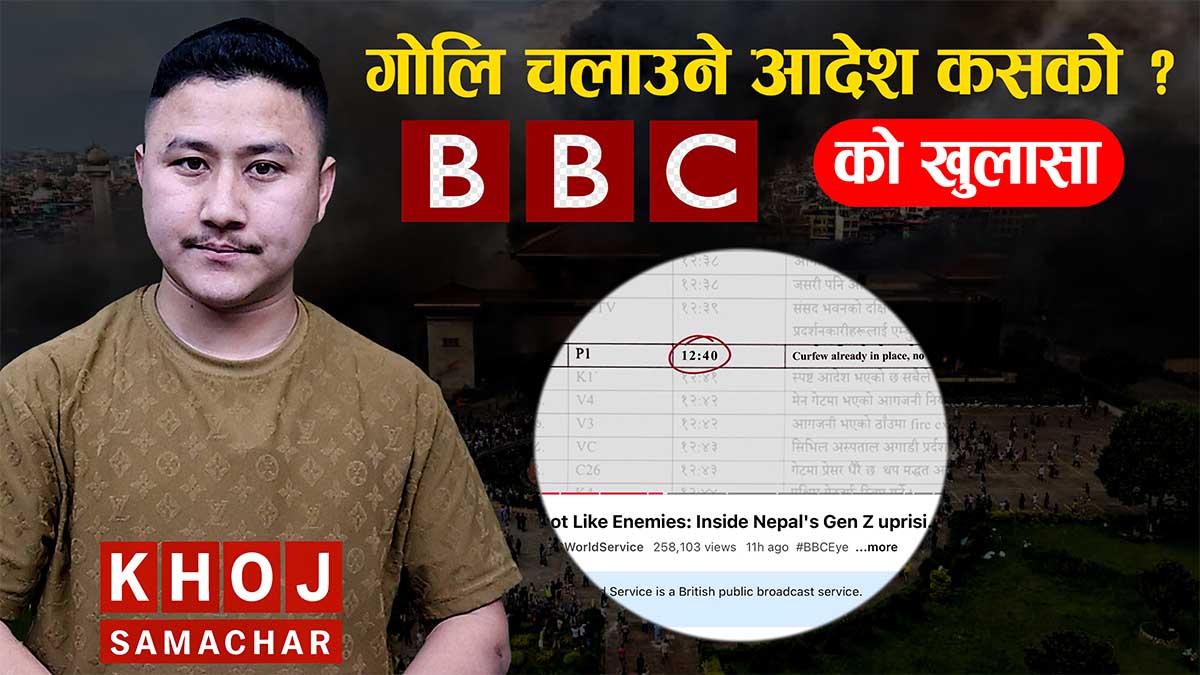
The BBC has published a 41-minute documentary examining the events of Bhadra 23 and 24, focusing on the Gen-Z protests that escalated into violence, led to the deaths of 19 young people, and resulted in widespread destruction of public property the following day.
The documentary, available on the BBC World Service website, presents new details regarding the chain of command, the use of force, and possible weaknesses within state security and intelligence mechanisms. While the report does not claim to provide a complete reconstruction of the two days, it raises significant questions about how key decisions were made.
A day before the BBC documentary was released, Khoj Samachar had published a video analysis on its YouTube and Facebook platforms discussing whether the decisive turning point occurred on Bhadra 23 or 24. That analysis can be viewed here.
In that video, Khoj Samachar argued that if then Prime Minister KP Sharma Oli had resigned on the evening of Bhadra 23, or if the army had been deployed from that night, the large-scale violence of the 24th might have been prevented.
The BBC report cites a police officer as saying that deploying even 100 to 200 army personnel on the streets could have helped control the situation. This assessment closely aligns with the argument presented earlier in Khoj Samachar’s analysis.
Order to Use Force Under Scrutiny
One of the central revelations in the BBC documentary concerns a recorded radio message allegedly transmitted at 12:40 pm on Bhadra 23 by then Inspector General of Police Chandra Kuber Khapung. According to the BBC, the message indicated that since curfew had already been imposed, officers did not need to wait for further instructions to use necessary force to bring the situation under control.
Khapung has publicly denied issuing such an order. He has stated that responsibility for security in Kathmandu that day lay with the Kathmandu Security Committee, led by then Chief District Officer Chhabilal Rijal.
Rijal, in a written response to the Supreme Court, maintained that he authorized the use of rubber bullets in coordination with senior officials but did not order the use of live ammunition. The identity of any higher-ranking official who may have authorized lethal force remains unclear.
The documentary also shows footage of police personnel inside the Parliament building firing up to seven rounds, with one young protester seen collapsing after being struck.
Intelligence and Preparedness Concerns
The BBC report highlights significant gaps in intelligence assessment and crowd management. Security agencies had reportedly estimated that around 3,000 Gen-Z demonstrators would gather on Bhadra 23. Instead, turnout was said to be nearly ten times higher.
Video footage shows thousands of protesters advancing toward the Parliament building while approximately 200 police officers were deployed behind barricades.
These findings mirror concerns raised in earlier analysis by Khoj Samachar, which pointed to weak prior intelligence, underestimation of crowd size, and insufficient coordination within the security chain of command as key factors behind the escalation.
Events of Bhadra 24 and Ongoing Questions
The documentary also references online messages shared on Discord late on the night of Bhadra 23, in which some users discussed acts of arson and the use of Molotov cocktails. Previous reports had suggested that similar materials were used during the fires on Bhadra 24. However, the BBC report does not draw a definitive conclusion about coordination or planning.
Despite presenting new evidence, several questions remain unresolved, particularly regarding who ultimately authorized the use of live ammunition and how decisions were communicated within the command structure.
An investigation commission led by Gauribahadur Karki has been tasked with examining the events in detail. Observers say its findings will be crucial in determining accountability and clarifying the sequence of decisions that shaped the two days.
For now, the BBC documentary adds further documentation to a complex and contested chapter, while earlier independent analysis had already raised many of the same concerns about political decision-making, security preparedness, and the management of the protests.


Written by Roshan Shrestha
Roshan Shrestha is a Nepali investigative journalist and founder of Khoj Samachar, covering corruption, transparency, and public-interest issues.
Nepal Moves to Standardise Burn Treatment Nationwide
Nepal to Impose VAT on Electricity Bills from Tomorrow
Nepal’s Free Treatment Portal Serves Over 2,200 in 90 Days
Minister Nisha Mehta Pushes Burn Care Across Seven Provinces
Nepal Supreme Court Opens Government Ads to Private Media
Full LPG Cylinders to Be Sold After Minister Yadav’s Order
Khawalung School Video: What Happened Between Teacher and Student?