Khawalung School Video: What Happened Between Teacher and Student?
The widely shared classroom footage has renewed questions about student welfare, staff conduct and hostel supervision at the Khumaltar school.


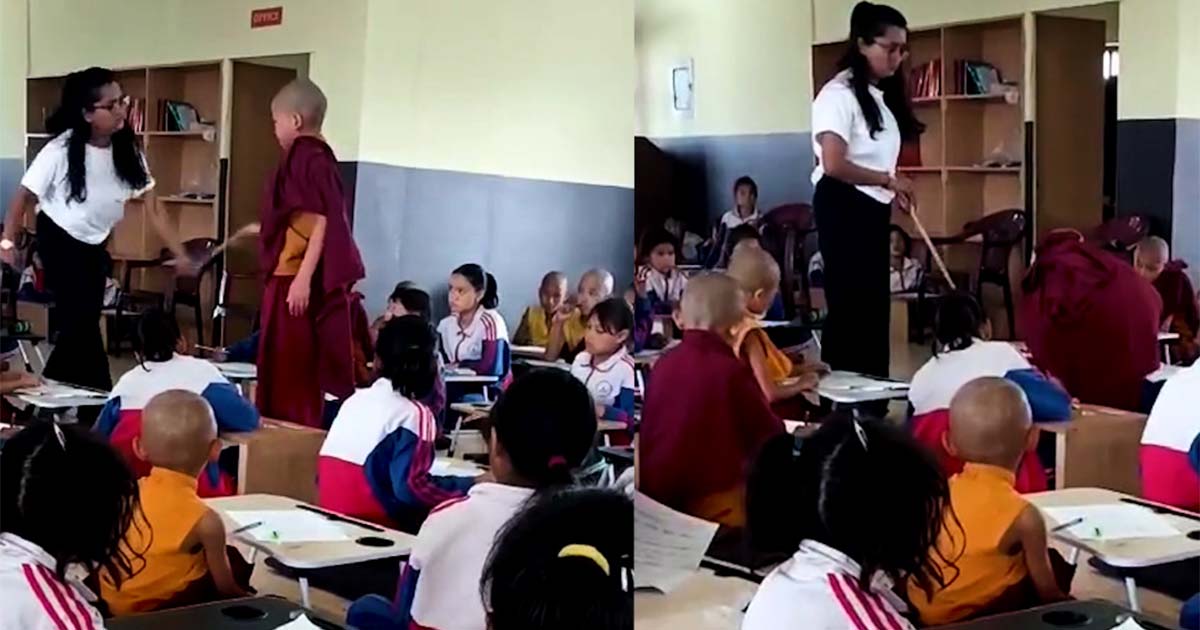
A video showing a teacher repeatedly striking a young monk on the hand with a stick has spread rapidly across Nepali social media, drawing widespread criticism of a monastery school in Khumaltar that teaches children the Buddhist principles of compassion and non-violence.
In the footage, a woman whom the school administration identified as former teacher Sona Rana is seen striking a boy dressed in monastic robes on the hand approximately six times. The child is seen crying afterward, while the woman remains visibly angry and continues scolding the students.
Her voice can be heard clearly in the recording as she accuses the students of disrespecting her and warns them not to challenge her authority.
Among the statements heard in the video are:
- “Are you disrespecting me because I haven’t hit you this year?”
- “Didn’t you see what happened yesterday?”
- “Aren’t you even a little afraid?”
- “You don’t know whose mouth was bleeding, do you?”
The final statement has attracted particular attention. The video does not explain what she was referring to, leaving viewers questioning whether an earlier and potentially more serious incident had taken place at the school.
School Says the Footage Is Old and the Teacher Has Left
Khawalung Monastery School, located in Khumaltar, has responded to the criticism by stating that the incident is not recent.
According to the school administration, the incident took place around a year and a half ago, in Falgun 2080 BS. The school has also stated that Sona Rana is no longer employed there.
However, these statements have not fully addressed the concerns raised by the public.
The school has not publicly clarified why the teacher left, whether her departure was directly connected to this incident, what action was taken at the time, or what support was provided to the child involved.
The school has also not explained the teacher’s reference to a student whose mouth had allegedly been bleeding.
Children Living Far Away From Their Families
Children studying at residential monastic schools often live away from their parents and families from a very young age. They stay in hostels while receiving both religious and general education.
Because these children live far from their guardians, schools and hostel administrators carry an even greater responsibility to ensure their safety, dignity, emotional well-being, and protection.
A school should be a place where children feel safe enough to learn, ask questions, make mistakes, and grow.
When fear and intimidation become part of the learning environment, the impact can be especially serious for children who do not have immediate access to their parents or guardians.
Questions the Public Wants Answered
Research and child-development experts have repeatedly warned that physical punishment and fear-based discipline do not improve learning.
Instead, such methods may contribute to anxiety, emotional distress, reduced confidence, and a negative attitude toward education.
Children may make mistakes or fail to follow instructions, but correcting their behaviour should involve guidance, communication, positive discipline, and appropriate educational support.
The school has reportedly asked the former teacher for an explanation. However, an internal explanation alone may not be enough to address the wider concerns raised by the incident.
The public is now asking several important questions:
- What is the current condition of the children living in the school’s hostel?
- Is fear or intimidation being used as a disciplinary method elsewhere on the campus?
- Do students have a safe and trusted way to report inappropriate behaviour?
- What specific steps has the school taken since the incident to prevent similar situations?
Why the Incident Requires Further Investigation
The fact that the video is old does not automatically make the issue less serious.
The incident raises broader questions about child protection, hostel supervision, institutional accountability, and the treatment of children studying in residential religious schools.
It also raises concerns about whether proper systems exist for students to report mistreatment and whether complaints are handled transparently.
Many people are now calling on the relevant authorities to conduct an independent and fair investigation into the incident.
Such an investigation should determine what happened, whether any other students were affected, what action was taken by the school, and whether the institution has introduced stronger child-protection measures.
The findings should be made public, while respecting the privacy and dignity of the children involved.
Without a transparent investigation, concerns about the safety and protection of other students are likely to remain unresolved.
- Children need trust, not fear.
- They need guidance, not punishment.
- Schools must provide a safe environment where every child can learn, grow, and build a secure future.
Watch the Full Video

Written by Pushpa Tamang
Pushpa Tamang is Managing Editor at Khoj Samachar, leading English and Nepali bureaus, newsroom operations, and editorial standards.
Nepal to Fine Fuel Pumps Up to NPR 1 Million for Shutting Down
Why Susta Residents Have Come to Kathmandu?
Nepal Government to Print National ID Cards Itself
Everything You Need to Know About the 2026/27 National Budget
Singha Durbar Toilets Remain in Poor Condition
Manoj Kumar Sharma Set to Become Nepal’s Chief Justice

Koshi Police Honors Inspector Sagar Sah for Innovative Policing