Sunil Lamsal Opens Nagdhunga Tunnel, Operations Begin Today
The country's first modern road tunnel begins phased operations, with emergency vehicles using the route first as authorities prepare for full public access.


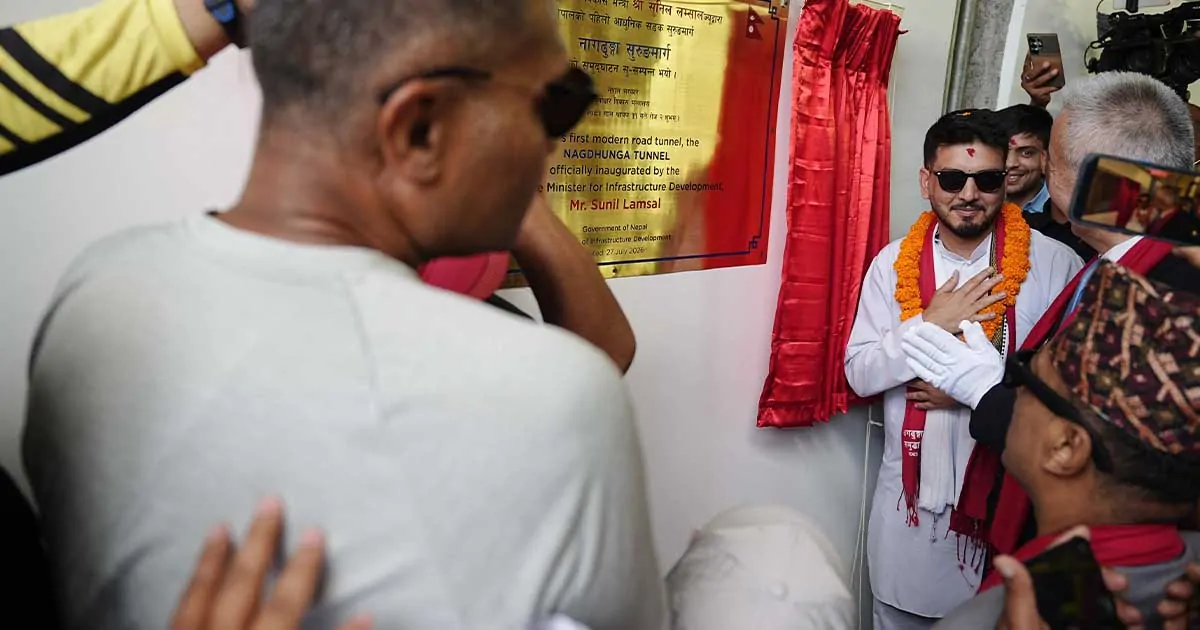
Nagdhunga Tunnel Road has formally entered service, marking Nepal’s first modern road tunnel to open after years of planning, construction and repeated delays. Built to ease chronic traffic congestion at the Nagdhunga checkpoint, the main gateway linking Kathmandu Valley with the rest of the country, the project is being seen not only as a transport upgrade but also as a test case for Nepal’s future investment in tunnel-based road infrastructure.
The tunnel was inaugurated on Monday by Minister for Infrastructure Development Sunil Lamsal in the presence of Japanese Ambassador to Nepal Maeda Toru and Japan International Cooperation Agency (JICA) President Dr. Tanaka Akihiko. The project was built with a concessional Japanese loan carrying an interest rate of 0.01 percent.
Although the tunnel has officially opened, public access will not begin immediately. Authorities said only emergency service vehicles, including ambulances and fire engines, will be allowed to use the facility during the initial phase while operators complete system testing, toll operations and staff training before gradually expanding access to the general public.
The phased rollout reflects the importance being placed on operational safety, with the tunnel introducing technology and management systems that have not previously been used on Nepal’s national highway network.
Government pledges to restore missing foundation plaque
During the inauguration, Minister Lamsal said the foundation stone installed during the project’s groundbreaking ceremony would be traced and reinstated.
Former Prime Minister KP Sharma Oli laid the foundation stone on Kartik 4, 2076 BS. Its subsequent removal, along with the plaque bearing his name, became a matter of public controversy.
Lamsal said the government would restore the missing plaque and ensure that the project’s full construction history is properly acknowledged.
A project shaped across multiple governments
The Nagdhunga Tunnel project has passed through several political administrations before reaching completion.
Its feasibility study was initiated around 2066/67 BS during the periods of Prime Ministers Jhalanath Khanal and Dr. Baburam Bhattarai.
Construction formally began after KP Sharma Oli inaugurated the project in 2076 BS. The breakthrough of the main tunnel took place during the tenure of Prime Minister Pushpa Kamal Dahal “Prachanda.”
The official opening now closes a development process that stretched over more than a decade and involved successive governments.
“Nepal has entered the tunnel era”
Speaking after the inauguration, Minister Lamsal described the project as the beginning of a new phase in Nepal’s transport infrastructure.
He said the experience gained from Nagdhunga would be used to advance tunnel road construction in other geographically challenging parts of the country.
“नेपाल has entered the tunnel era,” he said, describing the project as a milestone for modern road development.
Engineering features
The project includes:
- A 2.688-kilometre main traffic tunnel.
- A separate 2.557-kilometre emergency escape tunnel.
- Modern safety and operational systems designed for emergency response and tunnel management.
Toll charges
Vehicles will be charged according to category.
- Cars, vans, pickups, tractors, microbuses and other light vehicles: Rs 65 entering Kathmandu and Rs 60 leaving the valley.
- Minibuses and mini trucks/tippers: Rs 115 entering and Rs 80 leaving.
- Buses and single rear axle trucks: Rs 260 entering and Rs 200 leaving.
- Multi-axle trucks, heavy vehicles and heavy equipment: Rs 600 entering and Rs 250 leaving.
Vehicles barred from using the tunnel
Tunnel authorities said several categories of vehicles will not be permitted inside for safety reasons.
- Motorcycles and other two-wheelers.
- Vehicles transporting liquid fuel or gas.
- Vehicles carrying livestock or poultry.
- Vehicles transporting explosives.
Authorities expect the tunnel to improve traffic management along the Kathmandu–Naubise corridor, particularly during festivals and other peak travel periods when congestion regularly causes long delays. Officials also believe the project will shorten travel times and contribute to safer movement on one of Nepal’s busiest road links.

Written by Roshan Shrestha
Roshan Shrestha is a Nepali investigative journalist and founder of Khoj Samachar, covering corruption, transparency, and public-interest issues.
Nepal Moves to Standardise Burn Treatment Nationwide
Nepal to Impose VAT on Electricity Bills from Tomorrow
Nepal’s Free Treatment Portal Serves Over 2,200 in 90 Days

Minister Nisha Mehta Pushes Burn Care Across Seven Provinces
Nepal Supreme Court Opens Government Ads to Private Media

Full LPG Cylinders to Be Sold After Minister Yadav’s Order
Khawalung School Video: What Happened Between Teacher and Student?