Four Congress Ministers Resign from Karnali Government
Four ministers resign as the party accuses the UML of failing to honour a rotational leadership agreement.


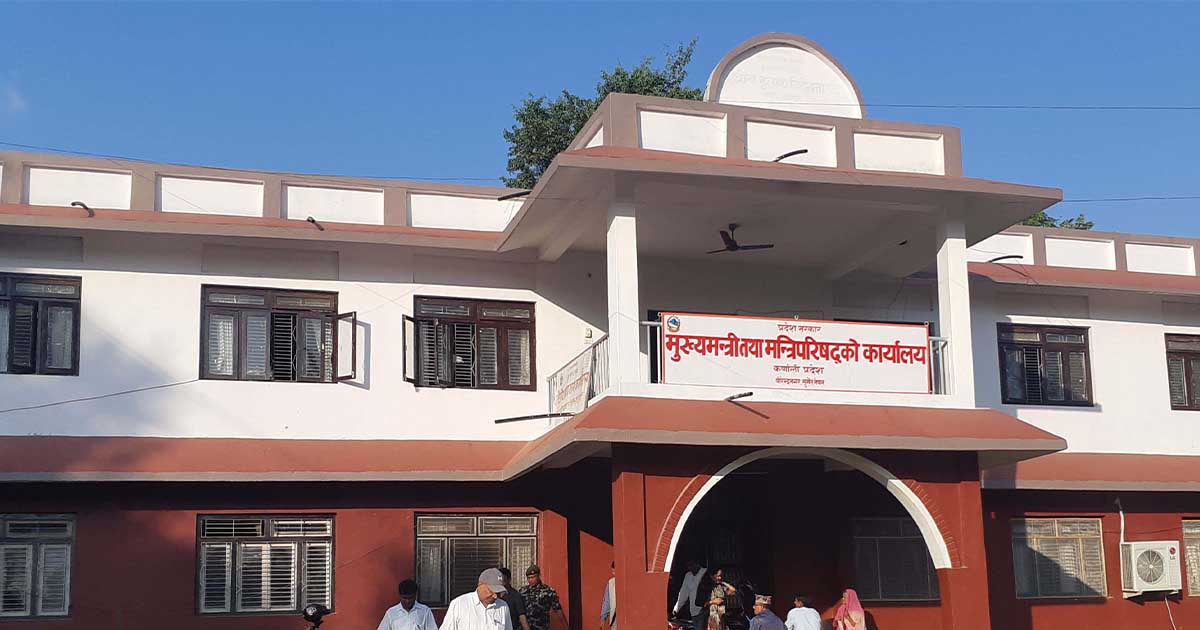
The Nepali Congress has withdrawn all four of its ministers from the Karnali provincial government, accusing the CPN-UML of failing to honour an agreement to rotate the chief minister’s position.
The collective resignations have stripped Chief Minister Yamlal Kandel’s Cabinet of its largest coalition bloc and left the UML-led government facing an immediate search for fresh political support. What began as mistrust over leadership-sharing has now become a broader test of whether the coalition still exists in practice.
Economic Affairs and Planning Minister Rajiv Bikram Shah, Water Resources and Energy Minister Vijaya Budha, Social Development Minister Ghanshyam Bhandari, and Industry, Tourism, Forest and Environment Minister Suresh Adhikari resigned from their posts.
The ministers submitted their resignations to Kandel during a meeting on Monday morning. Adhikari said the letters were formally presented to the chief minister during a Cabinet meeting.
Congress says UML failed to honour leadership deal
Congress leaders said the party decided to leave the government after concluding that the UML was unwilling to implement the earlier understanding on rotational leadership.
“There was an agreement in the past to rotate the leadership of the government,” Adhikari said. “We left the government after the UML showed no readiness to implement that agreement.”
The resignations also signal that Congress is preparing to reconsider the political support it has extended to the UML-led administration. A formal decision on withdrawing support, however, has yet to be announced.
Bhandari urged against immediately reading the resignations as confirmation that Congress was ready to form a new government under its own leadership.
He said the ministers had stepped aside after asking the chief minister to ensure that public work was carried out effectively.
“We have cleared the way. We have told the chief minister to deliver better work for the people,” Bhandari said.
Asked whether Congress was preparing to lead the next government, he said the party had not yet reached a concrete decision.
That distinction now matters. The ministers are out, but Congress has not publicly completed the next political step. Until the party formally decides what to do with its support, the Kandel government remains caught between a broken Cabinet arrangement and an unresolved parliamentary equation.
Shah submitted resignation before leaving for Bangkok
Shah is currently in Bangkok, Thailand, for medical treatment.
Before travelling abroad, he handed his resignation letter to Nepali Congress parliamentary party leader Jeevan Bahadur Shahi. Shah said he resigned in line with the parliamentary party’s directive.
The four resignations leave Kandel with the task of rebuilding a Cabinet that had been shaped around the Congress-UML partnership.
The seven-member provincial Cabinet had four ministers from Congress and three from the UML. Congress therefore held both a numerical and administrative advantage within the Council of Ministers. The departure of all four ministers at once makes a Cabinet reshuffle unavoidable.
It also weakens the political foundation on which Kandel had been governing.
Coalition formed after change in national power equation
Kandel was appointed chief minister on Chait 27, 2080 BS, with the support of the CPN (Maoist Centre).
The provincial arrangement later changed after a new political equation emerged at the federal level and Congress and the UML formed an alliance. That shift was reflected in Karnali, where Congress joined the provincial government in Shrawan 2081 BS.
The partnership had since formed the central base of the government in the 40-member Karnali Provincial Assembly.
Congress and UML leaders had repeatedly spoken of understandings to rotate provincial leadership in different provinces. In Karnali, growing distrust over the implementation of that arrangement eventually led to the collective resignation of Congress ministers.
The dispute has exposed the limits of coalition agreements that remain politically accepted but are not implemented within an agreed timeline. Congress entered the government as its dominant ministerial partner, but it has now walked out saying the central commitment behind that partnership was ignored.
For Kandel, filling the vacant ministries is only one part of the problem. The larger challenge is securing enough political backing in the Provincial Assembly if Congress formally withdraws its support.
Congress must now decide whether its exit from the Cabinet will be followed by a complete break with the government. The UML, in turn, must determine whether it can rebuild a majority through another political arrangement.
Those decisions will shape the next phase of power politics in Karnali.

Written by Roshani Shrestha Pathak
Roshani Shrestha Pathak is the English Bureau Chief at Khoj Samachar, overseeing English-language editorial operations and newsroom coordination.
ANNFSU Students Protest at Singha Durbar South Gate
Manish Jha Calls for Investigation Into Media Blockades
Fake Bhutanese Refugee Scam in Nepal: Full Verdict and Sentences
Rabi Lamichhane Promises Action Over Gate Blockade
Sudan Gurung Makes Citizens Feel the State Is Present
RSP Puts Som Sharma Back on Central Committee
Majid Ansari and Gen Z Arrests Raise Kirtipur Police Questions