Sudan Gurung Makes Citizens Feel the State Is Present
From hospitals to displaced settlements, Sudan Gurung’s field presence has brought the government closer to citizens in crisis.



When Sudan Gurung was appointed home minister, the criticism came quickly. His experience, capacity and suitability for one of the government’s most demanding ministries were openly questioned. Many concluded that the new administration had made a poor choice at the very beginning.
Nearly four months later, Gurung is being seen in a different role.
His presence during two recent humanitarian crises has not resolved the deeper failures behind them. But it has delivered one message that citizens do not often receive from the state: when people are in distress, someone in government can still turn up.
That should be ordinary public duty. In Nepal’s administrative culture, it is not.
Ministers rarely spend hours with grieving families, remain at hospitals through difficult moments or repeatedly enter the field to coordinate a settlement. Gurung’s visibility has therefore drawn attention not because such work is extraordinary, but because the state’s normal machinery so often remains distant.
The contrast is becoming central to his tenure. A minister is moving quickly. The institutions under the government are not.
A death outside the passport office
A few days ago, 25-year-old Ganesh Nepali of Mugu attempted self-immolation outside the Department of Passports in Kathmandu.
He was taken to Bir Hospital in critical condition. Gurung reached the hospital and sought direct information about his treatment and the circumstances surrounding the incident.
Ganesh died the following day.
The death of a young citizen after an act of desperation outside a government office raised serious questions about public service delivery, access to the state and the sensitivity of the administration. Anger spread from the streets to social media and Parliament. The case was also at risk of being swallowed by political accusation and counter-accusation.
Gurung brought together the Kathmandu chief district officer, representatives of Kathmandu Metropolitan City and other concerned sides to begin talks with the family.
After nearly 48 hours of continuous discussion, the family and government representatives reached a nine-point agreement.
The talks did not erase the tragedy. Nor did an agreement answer why Ganesh had reached such a desperate point. But the engagement prevented the family from being left alone in a moment when distrust of the state was already deepening.
The process also addressed a citizenship-related problem faced by Ganesh’s wife, Ekmaya Nepali.
The administrative procedure should normally have been completed in Mugu. Instead, coordination was carried out in Kathmandu, the citizenship certificate was issued and Gurung personally handed it to her.
This was not a favour. Citizenship is a right, and speaking to a bereaved family is a government responsibility.
Yet the speed with which the system moved after ministerial intervention revealed something uncomfortable. The administration was capable of acting. It had simply not acted earlier.
A citizen should not have to die before paperwork begins moving.
Another test among displaced families
Even as negotiations continued with Ganesh Nepali’s family, the government was confronting another crisis.
Families removed from informal settlements along the Bagmati river had initially been taken to a holding centre in Kirtipur. After the centre was affected by flooding, they were moved again, this time to Kharipati in Bhaktapur.
People removed from a flood-prone riverbank in the name of safety had suffered flooding under government management itself.
The contradiction was difficult to defend.
These families were not asking for political speeches. They needed shelter, food, security and treatment that recognised their dignity. Instead, weaknesses in the relocation process exposed them to another round of uncertainty.
Before the situation became more tense, Gurung reached Kharipati with six other ministers.
The sight of seven ministers standing before a displaced community was unusual. Their presence did not immediately solve the housing crisis. It did, however, open a direct channel with people who had long felt that the state heard them only when it wanted their settlement cleared.
Gurung apologised for the way the displaced citizens had been treated by the state.
In a political culture where those in power often resist admitting failure, the apology mattered. Its lasting value, however, will depend entirely on what follows.
Food distribution to the displaced families had also been stopped. It resumed after the home minister’s intervention.
That is immediate relief, not rehabilitation.
The government must now move beyond temporary meals and improvised shelter. Safe housing, health care, education, employment and a clear long-term resettlement plan cannot be replaced by ministerial visits.
Managing the damage from an earlier decision
The removal of the settlements has faced criticism because it was carried out without adequate preparation.
Women, children, elderly people and families dependent on daily wages were among those most affected when settlements were cleared without a secure alternative already in place.
Gurung was not serving as home minister when that decision was implemented.
He had stepped away from the ministry while an allegation involving assets of unexplained origin was being investigated. During that period, the Home Ministry was under Prime Minister Balen Shah, and the direction to remove the settlements was issued while the ministry was under his control, as stated in the source material.
Gurung later returned to the ministry.
The investigation committee’s report, however, was not made public before his return. That remains a serious transparency issue.
When allegations are made against a public office holder, citizens have the right to know what an inquiry found. Reappointment alone is not an answer. A government cannot demand trust while withholding the document that is supposed to establish whether that trust is justified.
Since returning to the Home Ministry, Gurung has been trying to reduce the anger created by the settlement removal and reopen communication with the displaced community.
That can also be understood as damage control after a decision taken under the prime minister’s watch.
A division is beginning to appear inside the government’s public image. Decisions are being made without sufficient preparation, while Gurung is increasingly being sent—or choosing to go—to the places where their social consequences have become impossible to ignore.
It is politically useful for the government to have a minister willing to absorb public anger. It is also risky. Crisis management can protect an administration from immediate fallout, but it can also hide who made the original decision and why the groundwork was so weak.
A visible minister cannot replace a functioning state
The recent incidents have brought Gurung forward as one of the main figures connecting the government with distressed citizens.
He went to the hospital. He remained engaged with the bereaved family. He mobilised administrative offices. He reached the displaced settlement. He apologised on behalf of the state.
These actions should not be romanticised. They are part of a minister’s responsibility.
Still, they cannot be dismissed in a political environment where ministers often remain inside Singha Durbar while citizens struggle outside government offices.
In the Ganesh Nepali case, the absence of timely dialogue could have led to further tension. Political actors were already attempting to frame the incident around their own interests. Reaching an agreement with the family was important as an immediate act of crisis management.
But one minister’s movement from hospital to settlement cannot build a citizen-friendly state.
Why did a young man reach the point of attempting self-immolation outside the passport office?
Why did a vulnerable family need a national crisis before a citizenship issue could be resolved?
Why were displaced families moved without basic arrangements for safety?
Why was food distribution stopped?
The government must answer these questions institutionally.
Gurung’s current approach may reduce anger after a crisis. The harder task is preventing the next one. That requires administrative reform, clear responsibility and public disclosure, not only personal intervention from a minister.
This is the new angle through which Gurung’s performance will increasingly be judged. His field presence has created political visibility, but every successful intervention also exposes a department or agency that failed before he arrived.
The more often a minister has to personally unlock the system, the clearer it becomes that the system itself is locked.
The secretariat now faces scrutiny
Questions are also being raised about whether Gurung’s secretariat is matching the pace and public approach of the minister.
A minister may try to remain accessible, but a weak secretariat can close the same doors he is attempting to open. Problems involving access, information, coordination and public conduct eventually become problems for the minister himself.
A secretariat is not a place to accommodate personal associates or reward political loyalty.
It is supposed to function as a professional bridge between the ministry, citizens, journalists and other stakeholders. Without competence, responsibility and accountability, even a minister’s useful work can be damaged by poor communication and avoidable controversy.
Gurung needs to review the performance of his secretariat before those weaknesses become part of his own public record.
Those failing to carry out their responsibilities should receive clear instructions. Structural changes should follow where necessary.
When the government was formed, Sudan Gurung was widely treated as one of its weaker appointments. He has now become one of the ministers most visibly present when citizens are facing immediate distress.
That is a change worth recognising.
But the real test has only begun.
His record will not be decided by hospital visits or apologies alone. It will depend on whether agreements with victims are implemented, whether displaced families receive secure lives, whether administrative failures are corrected and whether Gurung himself answers the questions surrounding transparency.
For now, one conclusion can be drawn.
At a time of crisis, citizens have seen at least one face of the government outside its offices.

Written by Roshani Shrestha Pathak
Roshani Shrestha Pathak is the English Bureau Chief at Khoj Samachar, overseeing English-language editorial operations and newsroom coordination.
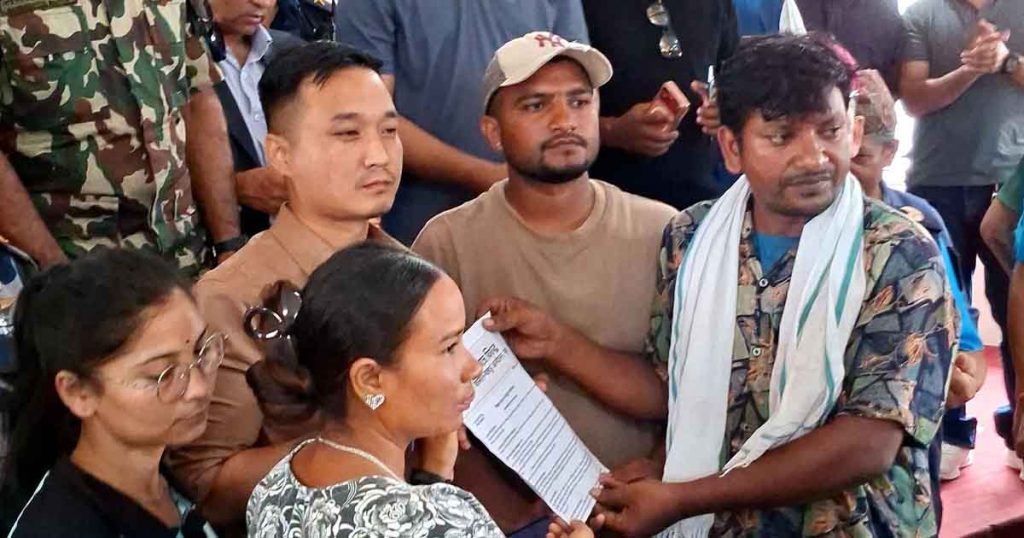
Sudan Gurung Meets Predatory Lending Victims in Bara
RSP Puts Som Sharma Back on Central Committee

Majid Ansari and Gen Z Arrests Raise Kirtipur Police Questions
Kulman to Energy Minister: Give NEA a Full-Time Chief

Is the Balen Government Heading Toward Authoritarianism?

Santosh Rajbanshi: When Will Farmers Get Fertilizer?

Lima Adhikari Urges EU Air Safety List Review