Majid Ansari and Gen Z Arrests Raise Kirtipur Police Questions
Four people were detained at the flooded holding center as concerns grew over police conduct and the treatment of displaced families.


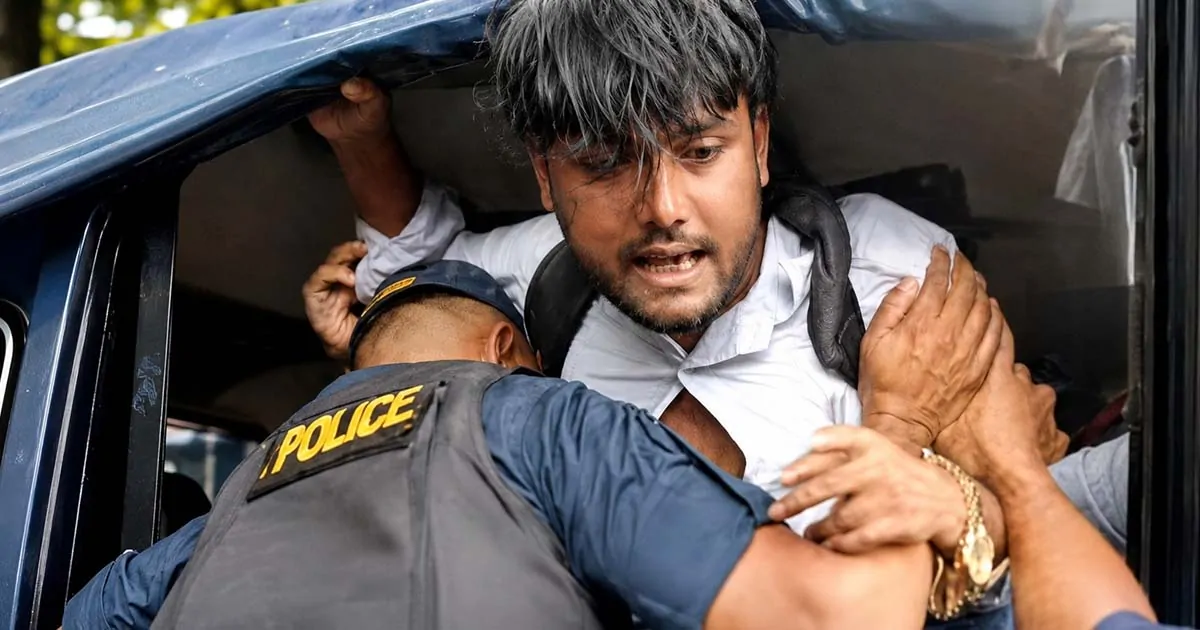
Police have taken four people into custody from the flooded holding center in Kirtipur after they spoke against the government and challenged the treatment of displaced squatters.
Three of those detained are associated with the Gen Z movement, while one is a leader from the squatter community. Those arrested are Narendra Khadka, Majid Ansari, Nahendra Khadka and Sarishma Thapa.
The irony could hardly be sharper: the very generation that raised its voice for political change and helped create the environment that brought this government to power is now being pushed into police vans for questioning that same government.
At this speed, the government may soon find itself in exactly the political position it once mocked its predecessors for.
Moved From One Riverbank to Another Flood-Prone Shelter
The Radha Soami Satsang building in Kirtipur stands close to a river. The fact that the shelter is vulnerable to flooding during the monsoon was neither hidden nor difficult to predict.
Yet a government and Cabinet filled with engineers and advisers failed to consider this basic reality while removing squatter families from the banks of the Bagmati and relocating them to another site exposed to floodwater.
The government rushed to deploy bulldozers, clear the settlement and move families away before the monsoon. But it failed to prepare a proper rehabilitation plan for the people it displaced.
Once their homes had been demolished, the state was responsible for providing them with food, drinking water, shelter, safety and other basic services until a proper alternative was arranged. Instead, families were moved in haste and left to struggle inside a poorly managed holding center.
The prime minister had proudly told Parliament that riverside settlements were being cleared before the rains to protect residents from annual flooding and loss of life and property.
But if floodwater had reached the Kirtipur shelter in previous monsoons, why did the same government fail to anticipate that it could happen again this year?
The government hurried the eviction, moved people from one riverbank to another and carried out demolitions without adequate preparation. It then failed to provide sufficient food and water at the holding center.
Now that the situation has deteriorated, those raising questions are being accused of provoking the displaced community.
Unable to Manage the Crisis, Ready to Arrest Its Critics
The government may be moving slowly on public service delivery, but its machinery appears remarkably fast when it comes to detaining people who speak against it.
Families at the holding center have lost their homes. Their children’s education has been disrupted. They are struggling with food, water, electricity, sanitation and an uncertain future.
Do citizens facing such conditions need an outsider to provoke them?
When people watch their homes being demolished and their children forced out of school, anger is a natural response. They should not need permission to cry, protest or speak to the media about their suffering.
Political leaders have themselves used extreme language when they were angry. They have threatened to burn Singha Durbar, spoken aggressively about national sovereignty and made reckless remarks about throwing opponents into the Tukucha.
But when a displaced resident, furious after losing his home, speaks about carrying a khukuri, the state immediately arrests and imprisons him.
The government must answer a straightforward question: how many people does it plan to detain, and from how many sectors of society?
Silencing citizens will not solve the failures that created their anger.
Fertilizer Shortage, Low Voltage, Rising Prices and Growing Debt
The Kirtipur incident has unfolded at a time when frustration with the government is already rising across the country.
The end of Asar is approaching, but farmers still cannot obtain fertilizer for their fields. In many areas, electricity voltage is too weak to operate water pumps. Prices of everyday goods have become increasingly difficult for ordinary families to afford.
The government is nearing three months in office, yet the country’s debt has already increased by around Rs 100 billion. Questions have also been raised over political appointments allegedly secured for relatives and people close to the prime minister.
As ministers approach their first 100 days, the government’s performance remains slower than a turtle’s pace.
Disorder is visible in nearly every sector. Under such circumstances, does anyone really need to incite the public against the government? The government’s own actions and failures are already producing enough anger.
A leader who became furious when a government vehicle carrying his wife was stopped should also understand the rage of parents watching their children’s education collapse after their homes were destroyed.
Before blaming activists for provoking citizens, the government should first take responsibility for its own decisions.
A few hundred thousand loyal supporters may applaud every action, but blind praise cannot erase administrative failure. History has repeatedly shown that rulers often become most arrogant shortly before their decline.
Majid Ansari Seen With Facial Injuries After Arrest
Among those detained from the Kirtipur holding center are squatter leader Narendra Khadka and Gen Z activists Majid Ansari, Nahendra Khadka and Sarishma Thapa.
A video made public during the arrest shows visible injuries on Majid Ansari’s face, along with several drops of blood.
Ansari later said that they were being held at the Kirtipur police post. He stated that he had been beaten and that blood was coming from his nose and mouth.
Another Gen Z activist, Amit Urja, said representatives of the Gen Z Movement Alliance had gone to the holding center to understand the condition of the displaced families. He accused police of assaulting the representatives during the visit.
The central question raised by the incident is impossible to ignore: when the same Gen Z that helped create the momentum for this government begins questioning its failures, will the government listen—or will it simply arrest them?
A government may exercise authority, but it must not turn authority into oppression.
Because when excess crosses the limit, political damage is inevitable.

Written by Roshan Shrestha
Roshan Shrestha is a Nepali investigative journalist and founder of Khoj Samachar, covering corruption, transparency, and public-interest issues.
Kulman to Energy Minister: Give NEA a Full-Time Chief

Is the Balen Government Heading Toward Authoritarianism?

Santosh Rajbanshi: When Will Farmers Get Fertilizer?
Lima Adhikari Urges EU Air Safety List Review
Bhutanese Refugee Scam: 16 Convicted, 7 Acquitted, 8 Fled

Kulman Ghising: Government Has Energy, Needs Experience
Jaybir Deuba Named in Money Laundering Notice