
Three Years Overdue, Seleghat–Ramechhap–Sanghutar Road Still Muddy
The issue came to light after Kusum Shahi submitted a complaint through Khoj Samachar’s Janata Sanga Media programme, highlighting the road’s prolonged delay and worsening condition.


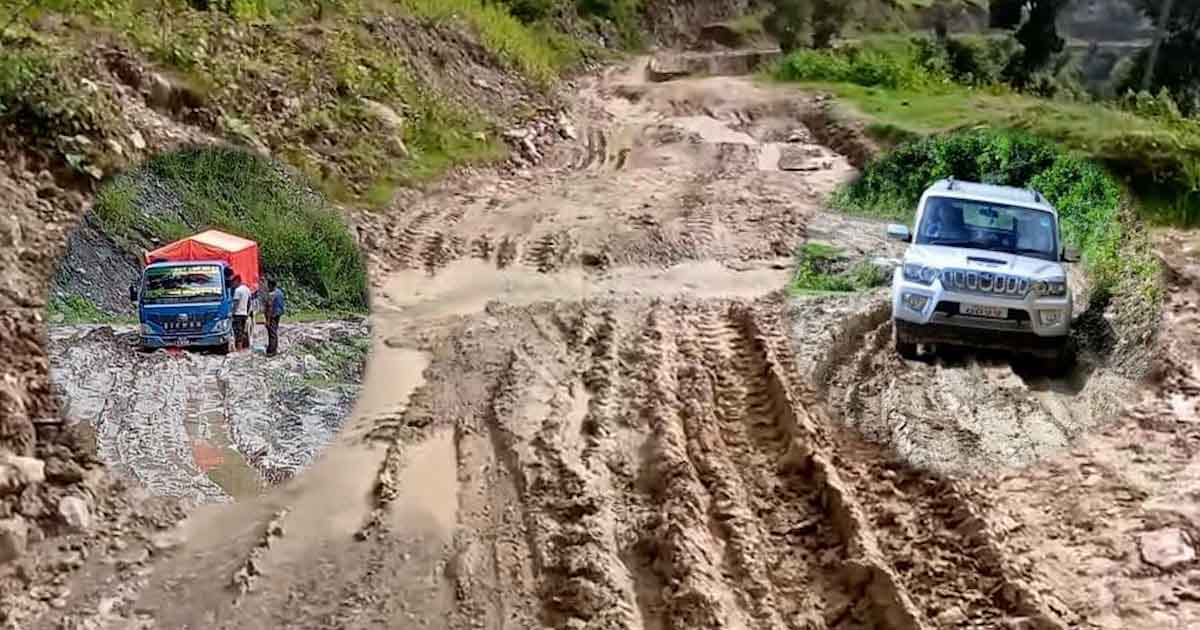
A road built to connect communities across Ramechhap and towards Okhaldhunga has instead become a recurring test of endurance for the people who depend on it.
The nearly 50-kilometre Seleghat–Ramechhap–Sanghutar road was supposed to be completed by May 2023. By the final week of July 2026, large sections were still muddy, sunken and filled with deep potholes. Passenger buses continue to get stuck. Journeys that should take a few hours become unpredictable as soon as the monsoon begins.
The condition of the road is not an isolated inconvenience caused by rain. It reflects a wider failure seen across Nepal, where tracks are opened in fragile hill terrain without adequate environmental and technical preparation, drainage is left unfinished, retaining structures remain weak and construction sites are abandoned for years.
Budgets are spent and progress is recorded. But the road remains unusable.
That gap between reported construction progress and what citizens can actually use is at the centre of this case. A project may be described as 60 percent complete on paper, but for a patient stranded in a bus, a student unable to reach class or a farmer unable to transport produce, an unsafe road is still an unfinished road.
A complaint sent through Janata Sanga Media
Kusum Shahi brought the condition of the road to Khoj Samachar through Janata Sanga Media, the newsroom’s citizen-focused public complaints programme. Khoj Samachar reviewed the information submitted by Shahi, visual material showing the recent condition of the road and details obtained from local sources.
The footage shows several sections covered in thick mud. Some potholes appear larger than vehicle tyres. In other places, the road surface has sunk or been washed away. Vehicles can be seen struggling to move, with some at risk of becoming trapped in the middle of the road.
Local residents said vehicles are sometimes stuck at the same location for hours during the rainy season. Passengers have to get out, push buses or look for another way to continue their journey.
The dry season brings a different problem.
Dust from the unpaved surface spreads into roadside houses, shops and settlements. Residents say they are forced to keep doors and windows closed, while homes near the road remain coated in dust throughout the day.
A daily route for buses, patients and students
At least four passenger buses use the road every day, according to information provided by the complainant and local residents.
Two buses travel from Ramechhap to Kathmandu, while two return from Kathmandu. Three to four sumo vehicles and other smaller vehicles also use the route daily.
The road is used by people from Ramechhap, Okhaldhunga and nearby areas travelling to Kathmandu or district headquarters. It is not an occasional route. Patients, elderly people, pregnant women, students, employees and people travelling for everyday work depend on it.
During the monsoon, no one can reliably estimate where a vehicle will become stuck or how long the delay will last.
When one large bus is trapped in the mud, vehicles behind it are also forced to stop. Passengers may remain inside for hours. Some have to walk through muddy sections. Others help pull or push the vehicle before the journey can resume.
For people travelling for medical treatment or other urgent work, the delay is not merely uncomfortable. It can determine whether they reach their destination on time.
Rs 1.94 billion project remains incomplete
Publicly available project details show that the approximately 50-kilometre Seleghat–Ramechhap–Sanghutar road was estimated to cost around Rs 1.94 billion.
The project was launched with loan assistance from the Indian Exim Bank. The construction contract was awarded to Telecommunications Consultants India Limited, or TCIL, a company owned by the Government of India.
Construction began towards the end of 2020.
The main contractual timeline was clear:
- Construction started in late 2020.
- The original completion deadline was May 10, 2023, corresponding to Baisakh 27, 2080.
- By August 2025, the project chief said physical progress stood at around 60 percent.
- The contractor was granted another extension and promised to deploy machinery and place gravel in difficult sections.
- Visual material received by Khoj Samachar showed muddy, damaged and sunken sections still remaining on July 24, 2026.
More than three years have passed since the original deadline.
The project timeline has been extended repeatedly, but the changes have not produced the level of improvement passengers were promised. The public still experiences the road as a dangerous and unreliable route.
Construction percentages alone cannot be treated as proof of success when citizens cannot travel safely.
Rain exposes unfinished engineering
Nepal’s monsoon regularly brings floods, landslides and fatal road incidents. Hundreds of people lose their lives in disasters, and entire settlements are placed at risk.
The country’s naturally fragile hill geography makes road construction difficult. It also makes technical discipline more important.
On this road, however, the rainy season exposes work that remains incomplete. Water collects on the surface because proper drainage has not been provided in several places. Rainwater runs directly along the road, cutting through the surface and turning unpaved sections into mud.
In steep areas, there is a risk of landslides falling from above and the road collapsing towards the lower slope.
Residents also say older structures were demolished during construction but replacements were not completed on time. The unfinished structures have added to the danger rather than reducing it.
This is how a delayed construction project becomes a disaster risk.
The road affects access to treatment, education, local markets and public services. It determines whether agricultural products can be transported and whether small businesses can receive supplies. Its condition reaches into almost every part of local life.
The government owes more than angry speeches
Physical Infrastructure and Transport Minister Sunil Lamsal publicly said contractors who fail to work should be found and even have their “legs broken”. The remark drew criticism.
Citizens do not need violent language from a minister. They need the law to work.
Breaking a contractor’s legs is not a solution. The government’s responsibility is to enforce the contract, ensure that quality construction is completed within the agreed period and take legal action when contractual conditions are violated.
In the case of the Seleghat–Ramechhap–Sanghutar road, the ministry and the project office must disclose the full status of the extended deadline, the work already completed, the remaining construction, payments made to the company and the reasons for the delay.
If the government has an objective basis to believe TCIL can finish the work, it must publish a credible schedule and enforce regular quality monitoring.
If the company has repeatedly failed despite receiving extensions, and if contractual violations are established, the government must be prepared to complete the legal process and cancel the contract.
There must also be accountability for the hardship imposed on local residents, the financial burden on the state and the losses caused by years of delay.
A new fiscal year, but the same unfinished road
Government ministries are announcing new plans and budgets as another fiscal year begins. Yet projects launched years ago with investments running into billions of rupees remain incomplete.
Before announcing more projects, the government must review the condition of existing ones, the capacity of construction companies, payment records and responsibility for delays.
The Seleghat–Ramechhap–Sanghutar road is not only a Ramechhap issue. Similar problems exist across the country: contractors failing to complete work, deadlines being extended again and again, weak monitoring and public institutions remaining indifferent to the suffering caused by unfinished infrastructure.
Winning a road contract is not simply the right to spend a public budget. It carries a responsibility to provide citizens with safe and reliable transport.
How long will a road used daily by people from three districts remain buried in mud during the monsoon and covered in dust during the dry season?
What action will be taken if the contractor fails again within the extended deadline? Who accepts responsibility for the delay so far?
The Ministry of Physical Infrastructure and Transport, the Department of Roads, the responsible project office and the construction company must provide clear answers.
Citizens are not asking for speeches. They are asking for a road they can travel on.
They are not asking for threats. They are asking for the work promised under the contract.
And they are not asking for violent statements. They are asking for responsibility and lawful action.
What is Janata Sanga Media?
Janata Sanga Media is a special Khoj Samachar programme created to bring citizens’ complaints, local problems and matters of public concern into the newsroom.
Nepalis living inside the country or abroad can send information, evidence and details of problems they have experienced through WhatsApp.
Khoj Samachar examines the available facts and supporting material before presenting verified complaints as news reports or special coverage.
The programme aims to give citizens without easy access to the media a channel through which their voices can reach responsible institutions and strengthen public accountability.

Written by Roshan Shrestha
Roshan Shrestha is a Nepali investigative journalist and founder of Khoj Samachar, covering corruption, transparency, and public-interest issues.
Why the Supreme Court Halted Nepal’s New Property Probe Commission
Fake Bhutanese Refugee Scam in Nepal: Full Verdict and Sentences
Arzu Rana and the Passport Scandal Explained: Inside Nepal’s E-Passport Probe
Janakpur Dham Waste Management Crisis Raises Public Concern

Sudan Gurung Reopens Nepal’s Palace Massacre Debate After 24 Years

What Nepal’s NHRC Gen Z Protest Report Reveals

What Is MoFA Mitra App and How to Use It?