Ekmaya Nepali Receives Citizenship After Ganesh’s Death
The certificate removes a key legal barrier as promised relief, employment and education support remain pending.


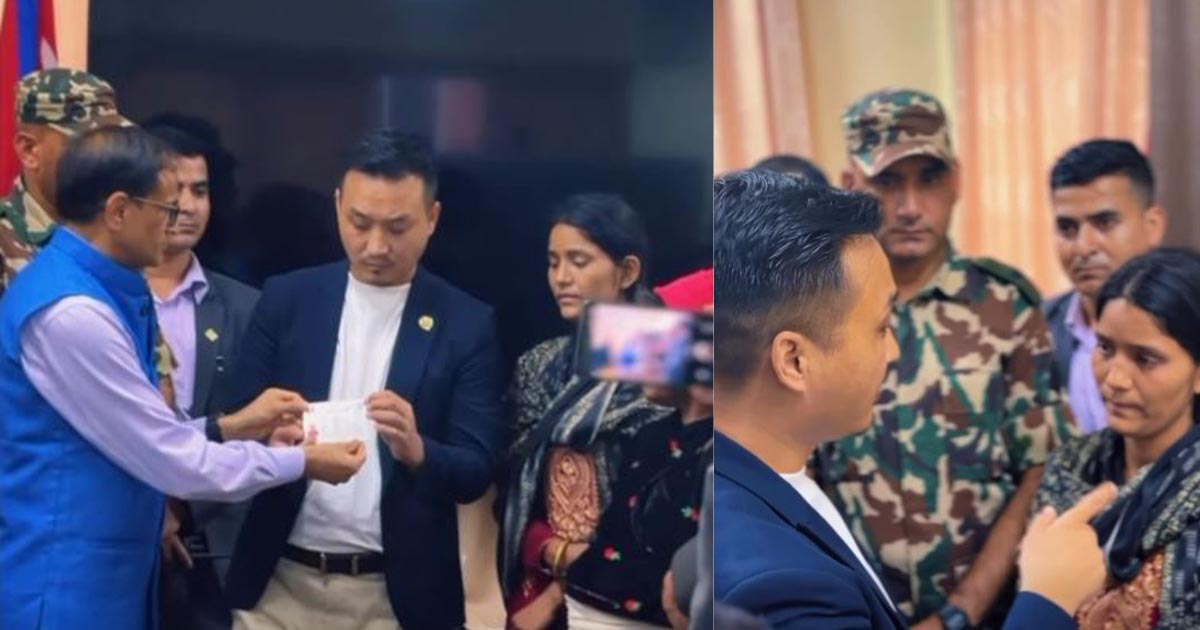
Ekmaya Nepali, the wife of Ganesh Nepali, who died in hospital after an attempted self-immolation, has finally received her Nepali citizenship certificate. Home Minister Sudhan Gurung handed over the document at the District Administration Office in Kathmandu.
The certificate resolves a basic legal problem that had followed Ekmaya through the most difficult period of her family’s life. Without citizenship, she could not open a bank account in her own name. Arrangements involving an account for her daughter were also difficult. Relief, social security support and other assistance available through government and non-government bodies remained out of reach or could not move through formal channels.
Her citizenship has been issued at a time when the government is under pressure to implement the nine-point agreement reached with Ganesh’s family after his death.
The document does not itself deliver relief, employment or long-term security. But without it, much of what the government has promised could not properly begin.
A document tied to every promised measure
The government’s agreement with the family includes employment for Ekmaya based on her qualifications and capacity, education expenses for Ganesh’s daughter up to the higher education level to be covered by Kathmandu Metropolitan City, and relief for the dependent family.
Each of those commitments requires paperwork.
Citizenship, a bank account and other official documents establishing the family’s identity are necessary for relief payments, employment procedures and access to public support. With the citizenship certificate now issued, Ekmaya can open an account in her own name and proceed with the administrative work required to receive assistance.
The family had said that even individuals and organisations willing to help were finding it difficult to transfer money through formal means. The absence of a bank account also created problems in collecting and managing financial support transparently.
This made citizenship more than an identity document in Ekmaya’s case. It had become the administrative point at which nearly every promise to the family was blocked.
Home minister hands over certificate
Home Minister Gurung reached the District Administration Office in Kathmandu and personally handed the citizenship certificate to Ekmaya during a brief programme.
The process was initiated after it became public that the family had not completed even the basic documentation needed to access relief and other services.
With the certificate, Ekmaya is expected to face fewer barriers in opening a bank account, accessing government services and relief schemes, and carrying out legal and administrative work in her own name.
The step is the first visible administrative movement following the agreement between the government and the family. The larger commitments remain unfinished.
Ganesh’s death and the nine-point agreement
Ganesh Nepali was a permanent resident of Jamaldhara in Soru Rural Municipality–6, Mugu. He had recently been living in Kamalbinayak, Bhaktapur.
He was seriously injured after attempting self-immolation and later died while undergoing treatment at Bir Hospital.
Following his death, the family demanded an impartial investigation into the incident, action against those responsible, immediate relief and long-term arrangements for the family’s security.
The family agreed to receive Ganesh’s body and proceed with the final rites only after reaching a nine-point agreement with the government.
The agreement includes:
- Formation of an independent investigation committee under the leadership of a former judge
- Correspondence seeking the immediate suspension of metropolitan police personnel deployed at the front line at the scene
- Relief for Ganesh’s dependent family
- Employment for Ekmaya based on her qualifications and capacity
- Education expenses for Ganesh’s daughter up to higher education to be covered by Kathmandu Metropolitan City
- Measures intended to secure the future of his wife and daughter
The family had raised the issue not only as a demand for compensation but also as one of accountability and long-term survival after the loss of its main support.
Implementation remains the real test
Ekmaya’s citizenship now creates a formal route for relief money to be deposited and managed in her name. It also allows the employment process and other government assistance to move forward.
But the main parts of the agreement have yet to be implemented in practice.
The amount and delivery of relief, the promised employment, support for the daughter’s education and the proposed long-term arrangements for the family remain pending. The investigation mechanism and action connected to the incident will also determine whether the agreement moves beyond immediate crisis management.
For now, the government has removed one administrative barrier.
For Ekmaya and her daughter, that barrier had stood in front of almost everything else.

Written by Roshani Shrestha Pathak
Roshani Shrestha Pathak is the English Bureau Chief at Khoj Samachar, overseeing English-language editorial operations and newsroom coordination.
What Did Ganesh Nepali’s Family Agree With Government?
Home Minister Leads Team to Kharipati Holding Centre
Ganesh Nepali Dies During Treatment at Bir Hospital
What Kulman Ghising Said After the Ganesh Nepali Incident
Unpaid Traffic Fines to Block Transport Services
‘We’re Not Balen’s Police’: Kailali DSP Called In Over Viral Speech
What Allowances Do Nepal Oil Corporation Employees Get?