Home Minister Leads Team to Kharipati Holding Centre
Government team assesses immediate needs and long-term rehabilitation plans for families relocated after flooding in Kirtipur.


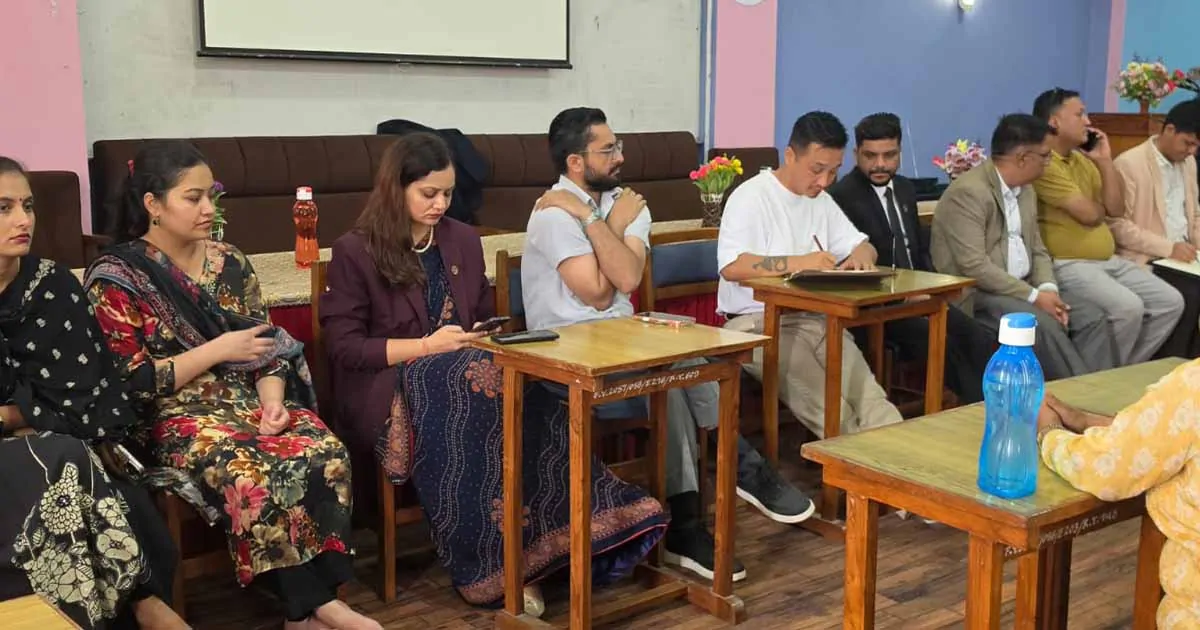
A ministerial team has visited the holding centres in Kharipati and Bode to assess the condition of landless families moved from Kirtipur after their temporary shelter was flooded. The inspection focused on immediate living needs, basic services and the government’s longer-term plan for families who remain without secure housing or recognised land rights.
The visit brought together ministries responsible for security, land, health, employment, education and social protection. It also placed two connected questions before the government: how to protect the displaced families now, and how to ensure that another temporary centre does not become an indefinite substitute for a permanent settlement policy.
Ministerial team meets displaced families
The team was led by Home Minister Sudhan Gurung. Government spokesperson and Minister for Education and Sports Sasmit Pokharel, Minister for Land Management, Cooperatives, Federal Affairs and General Administration Pratibha Rawal, and Minister for Women, Children, Gender and Sexual Minorities and Social Security Sita Badi joined the visit.
Health and Food Hygiene Minister Nisha Mehta and Youth, Labour and Employment Minister Ramji Yadav also inspected the holding centres.
The ministers spoke directly with the families staying there and listened to their concerns about housing, safety, basic services and what would happen next.
The Home Minister’s secretariat said the families were also informed about measures the government could take immediately and the preparations under way for a permanent solution.
For those moved from Kirtipur, the concern is no longer limited to surviving the flooding. Their stay in Kharipati has again exposed the uncertainty that follows landless families from one temporary arrangement to another.
Land ownership certificates only after legal process
Land Management Minister Pratibha Rawal said land ownership certificates would be issued only after the required legal and administrative procedures had been completed.
She said the government was working to make the process transparent and free from dispute so that questions would not arise over the decisions later.
Rawal also acknowledged that the problem could not be resolved within a short period. A lasting settlement, she said, would require the identification of genuinely landless families as well as those living in unplanned settlements.
She urged political actors not to use the vulnerable condition of landless communities for political interests.
Her remarks point to the difficult stage ahead. Immediate relief can be arranged through shelter and basic services, but decisions over identification, relocation and land ownership carry legal, administrative and political consequences. The government will be judged not only by the speed of its response, but also by whether the process is seen as fair.
Flooding forced relocation from Kirtipur
The families had been staying at the holding centre in Kirtipur before flooding made the facility unusable. They were then transferred to the holding centre in Kharipati.
Concern over their living conditions, security and access to basic services increased after the relocation, prompting the ministerial inspection of the centres in Kharipati and Bode.
The government has said it will address urgent needs while also working on a broader plan covering identification, rehabilitation and the eventual distribution of land ownership certificates to eligible families.
For the displaced families, however, the immediate issue remains straightforward: they need a safe place to live while the government carries out a process that it has already warned will take time.

Written by Roshan Shrestha
Roshan Shrestha is a Nepali investigative journalist and founder of Khoj Samachar, covering corruption, transparency, and public-interest issues.
Ekmaya Nepali Receives Citizenship After Ganesh’s Death

What Did Ganesh Nepali’s Family Agree With Government?

Ganesh Nepali Dies During Treatment at Bir Hospital
What Kulman Ghising Said After the Ganesh Nepali Incident
Unpaid Traffic Fines to Block Transport Services
‘We’re Not Balen’s Police’: Kailali DSP Called In Over Viral Speech
What Allowances Do Nepal Oil Corporation Employees Get?