Why Did Ganesh Nepali Take This Step?
The case highlights the financial pressure on ride-sharing workers and growing concern over municipal and traffic enforcement.


For 25-year-old Ganesh Nepali, life in Kathmandu was already a monthly calculation with little room for failure: rent, a motorcycle instalment, petrol and food for his wife and three-year-old daughter.
He carried passengers through the Pathao ride-sharing platform. The income changed from day to day, but the bills did not. Even in a bad month, the motorcycle payment had to be made. The landlord had to be paid. There had to be food at home.
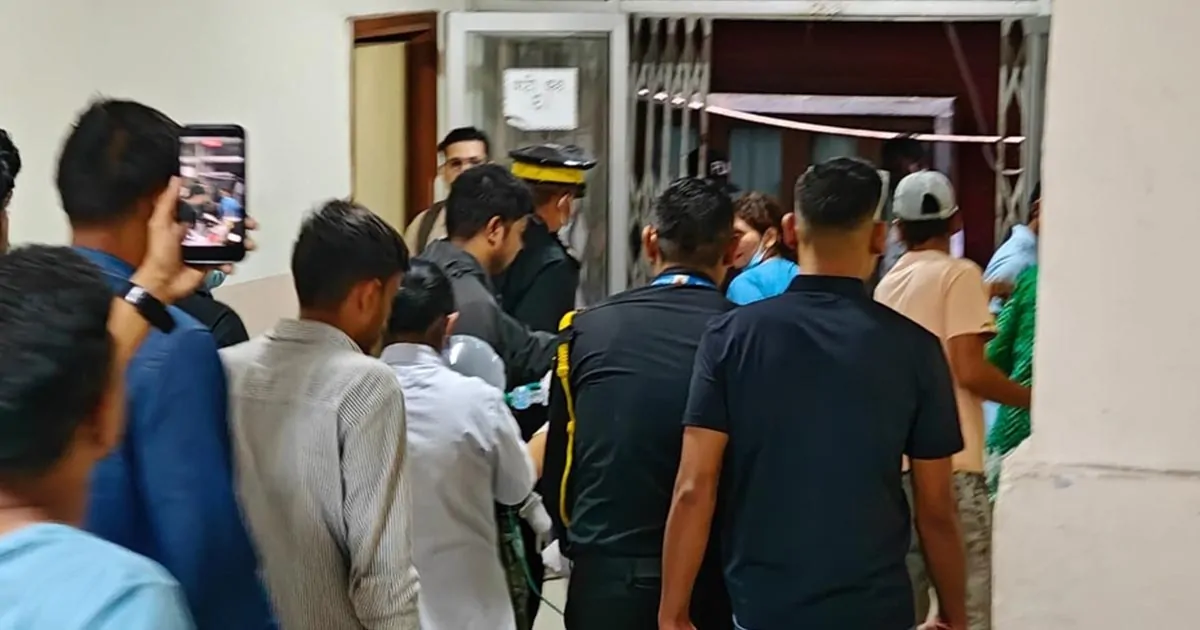
Ganesh later attempted to set himself on fire outside the Department of Passports. He remains under treatment with burns covering more than 60 per cent of his body. The government has decided to cover his medical expenses.
That decision matters. But the case cannot end with a hospital bill.
It has brought together several realities Kathmandu has allowed to remain separate for too long: insecure platform work, rising household pressure, a shortage of places where riders can legally stop, and an enforcement system increasingly experienced by low-income workers through locks, fines and confrontation.
The central issue is not whether traffic rules should exist. It is whether the state can punish workers for using a city that has not been designed to accommodate the work they are expected to do.
Signs of pressure before the incident
The available details do not suggest that Ganesh reached this point through a single sudden impulse.
In a message said to have been sent to his nephew, Man Nepali, on Ashar 13, Ganesh described going to collect goods and finding that municipal police had locked his motorcycle. He said he was required to pay Rs 1,000 and, after using the money for the fine, was unable to provide the goods he had been expected to deliver.
He ended the message with an emoji expressing distress.
One message cannot establish the full reason behind an act of self-harm. It should not be treated as a complete explanation. But it does indicate that financial loss caused by street enforcement had become part of a wider strain that Ganesh was already carrying.
His earnings were uncertain. His family expenses were fixed. A fine that may appear routine on an official receipt can take away petrol money, a day’s food or the amount set aside for a loan instalment.
That difference matters.
A proper inquiry must establish what happened in the period leading to the incident. It should examine the accounts of his family and fellow riders, records of fines imposed on him, and any encounters involving municipal or traffic police.
Without that work, the public will be left with official sympathy after the incident but no answer about the circumstances before it.
A city that depends on riders but gives them nowhere to stop
Kathmandu increasingly depends on motorcycle riders for passenger transport, food delivery and the movement of small goods. Yet the city has made little practical space for them.
There are no adequate designated areas where ride-sharing drivers can pick up or drop off passengers. Delivery workers often have nowhere to stop while handing over an order or collecting goods from a shop. Even a brief halt at the roadside can bring the risk of a wheel lock or a fine.
Stopping carelessly on a busy road can obstruct traffic and create danger. Rules cannot simply be suspended for everyone who says they are working.
But enforcement cannot be separated from infrastructure.
Kathmandu does not have enough parking. Existing parking areas are not easily accessible from every commercial or residential zone. It is not realistic to expect a rider collecting a small parcel to spend half an hour searching for parking before completing a task that may take only a few minutes.
The law currently makes little distinction between prolonged illegal parking and a short stop required for routine work. It also provides no meaningful accommodation for urgent or exceptional circumstances.
That leaves riders with a poor choice: fail to complete the job, or stop briefly and risk losing a significant part of the day’s earnings.
Claims have also circulated from ride-sharing and delivery workers who say they were fined while handing over goods without even removing their helmets. Those claims require official verification. The resentment behind them, however, cannot be dismissed.
For many workers, municipal and traffic authorities are no longer encountered as agencies that help manage movement. They are encountered as a financial threat.
Traffic management cannot be measured by fines alone
The primary responsibility of traffic police is to keep movement safe and orderly. Municipal police are responsible for enforcing metropolitan rules, managing public spaces and implementing local law.
Fines are one tool available to both systems. They are not the purpose of the system.
If penalties are increasing but unsafe behaviour, disorder and accidents are not falling, the government must explain what the enforcement model is achieving. A rising total of collected fines is not, by itself, evidence of better traffic management.
Public discussion has included claims that a large amount is collected each day in traffic penalties across Kathmandu Valley. Detailed official figures should be made public.
The authorities should disclose how much was collected, the offences for which penalties were issued, the areas where enforcement was concentrated and whether the measures reduced violations or accidents.
Without such transparency, suspicion will grow that enforcement agencies are functioning less as public service institutions and more as revenue collectors.
The question is also one of proportionality. A Rs 1,000 fine does not carry the same consequence for every citizen. For a salaried professional, it may be an inconvenience. For a rider whose income depends on completing several small trips, it can undo an entire day’s work.
Equal penalties on paper can produce deeply unequal harm.
That is where a rigid enforcement system becomes socially blind. It records the offence but not the economic position of the person being punished, the absence of alternatives or the actual effect of the penalty.
Municipal police and the politics of urban order
Complaints involving Kathmandu’s municipal police have grown alongside the force’s expanded numbers and visibility.
Street vendors, farmers, small traders, delivery workers and others who earn their living in public spaces have repeatedly described tense encounters with the city’s enforcement teams.
During former mayor Balen Shah’s tenure, municipal police were widely deployed to clear public spaces and enforce metropolitan rules more aggressively. Supporters viewed the approach as necessary to restore order in the capital.
Opponents argued that the city removed poor people’s livelihoods without first providing alternatives and allowed municipal police to develop into an institution associated with force and control.
Ganesh’s case has renewed demands from some quarters for the municipal police structure itself to be abolished.
That conclusion should not be reached without a serious review. The immediate need is to examine the force’s legal authority, working methods, accountability mechanisms and treatment of citizens.
The sharper question is not simply whether Kathmandu needs municipal police. It is what kind of institution the city has built.
Does it begin with warning, assistance and workable alternatives? Or does it begin with a wheel lock and a fine?
A city may clear a pavement or move a motorcycle and call the operation successful. But if the same action removes a person’s income without offering any lawful way to continue working, the disorder has not disappeared. It has been transferred into a household.
That is the part urban policy rarely records.
The state’s duty does not stop at treatment
The government’s decision to pay Ganesh’s medical expenses is a necessary and humane step. It is not a substitute for accountability.
An impartial investigation should determine whether he faced repeated fines, whether municipal or traffic officers mistreated him, and whether any official abused their authority. The findings should be made public. Any employee found responsible for misconduct should face action.
The state must also respond beyond this individual case.
Ride-sharing and delivery workers need designated pick-up and drop-off points. Kathmandu needs short-stay stopping areas for workers collecting or handing over goods. Affordable and accessible parking must be expanded.
For minor first-time violations, warnings should be considered before financial penalties. Fines should not impose a disproportionate burden on citizens with very low incomes. There must also be a simple and credible mechanism through which a person can challenge a penalty or report mistreatment.
Self-harm is not a solution to financial or administrative hardship, and it should never be presented as one. But the suffering, humiliation and helplessness that may precede such an act cannot be treated as an irrelevant private matter once state institutions are part of the account.
Ganesh is now fighting for his life.
As his family waits for his recovery, the government must confront a harder question: whether the machinery built to impose order in Kathmandu is making survival even more precarious for the people working at the edge of the city’s economy.
Justice for Ganesh cannot be limited to the cost of his treatment. It requires the truth about what brought him to that point, responsibility where wrongdoing is established, and policies that do not punish people for trying to earn a living in a city that has provided them no workable space to do so.

Written by Roshani Shrestha Pathak
Roshani Shrestha Pathak is the English Bureau Chief at Khoj Samachar, overseeing English-language editorial operations and newsroom coordination.
What Kulman Ghising Said After the Ganesh Nepali Incident
Unpaid Traffic Fines to Block Transport Services
Mahabir Pun Faces Criticism Over Relief Teacher Remarks
Bhishma Raj Angdembe Demands Fair Probe Into Gurung Case
Nepali Congress Sets Deadline for Membership Renewal
Harka Sampang Criticizes PM Balen Shah’s Absence
Government Separates Science Ministry Amid Mahabir Pun Demand