US-Iran Clash Raises Gulf Alarm After Drone Attacks
US strikes inside Iran and Tehran’s retaliation across the Gulf threaten shipping, energy flows and the fragile ceasefire.


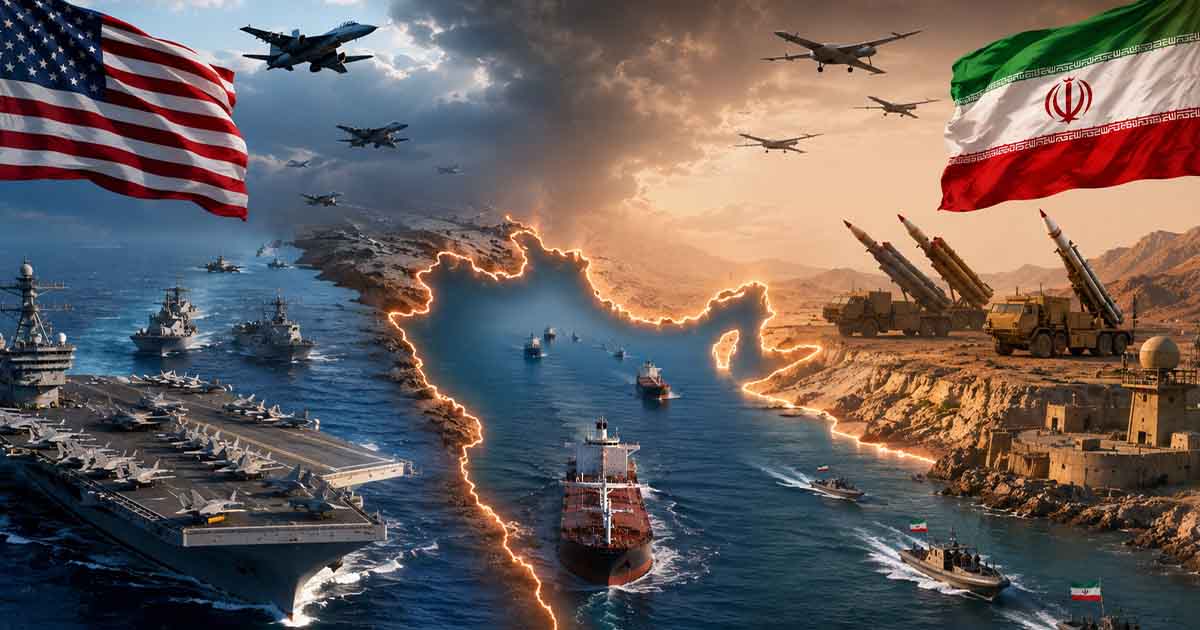
The United States and Iran have returned to direct military confrontation around the Strait of Hormuz, placing one of the world’s most sensitive energy corridors under renewed pressure and pushing a fragile 60-day understanding closer to collapse.
US forces say they struck around 140 military targets inside Iran after Tehran attacked a commercial vessel in the strait. Iran says its missile and drone response targeted American military facilities across the Gulf region.
The immediate dispute is over whether Hormuz remains open. The deeper confrontation is now over who decides how ships may pass through it. Iran insists vessels must follow routes approved by Tehran through its territorial waters. Washington says international navigation routes must remain open without such restrictions.
The passage has not stopped entirely, but commercial traffic has fallen sharply. That distinction matters little to shipping operators facing attacks, uncertain routes and the risk of being caught between two military powers issuing conflicting instructions.
US strikes military sites across Iran
US Central Command said the latest operation began on Saturday night and continued into Sunday morning, hitting missile and drone launch sites, weapons storage facilities, communications systems and other military structures inside Iran.
CENTCOM said the strikes were intended to weaken Iran’s ability to threaten commercial vessels and international navigation.
US President Donald Trump described the attack as “very tough”. Speaking on NBC’s Meet the Press, he said the two countries had been close to an agreement before Iran launched a drone attack on a commercial ship, prompting the American response.
Tehran has rejected Washington’s claim that a new agreement had been reached. Iranian authorities said they targeted only a vessel that had violated navigation rules and travelled outside an approved route.
The US military says it has now carried out three rounds of air strikes against Iran within a week in response to similar incidents.
Iranian state media said explosions were heard overnight in southern coastal areas. Military and energy-related locations around Bandar Abbas, Sirik, Chabahar, Jask, Asaluyeh, Bandar-e Deyr and Bushehr were among the areas said to have been targeted.
Iranian media said a naval officer had been killed. A full account of casualties and damage has not been made public.
Fire aboard GFS Galaxy, Indian crew member missing
The Cyprus-flagged container ship GFS Galaxy was attacked in the Strait of Hormuz, according to Omani authorities.
A fire broke out on the vessel after the attack. At least 23 sailors were rescued after a distress signal was received, but one crew member remains missing.
The missing sailor has been identified as an Indian citizen.
Iran said the vessel had moved outside the route authorised by Tehran and was targeted for violating its rules. The United States has treated the incident as a direct attack on commercial navigation.
The two explanations leave ship operators in a dangerous position. A vessel may be considered compliant by one side and a military target by the other. With no common mechanism for determining safe passage, navigation itself has become part of the conflict.
Iran targets US military presence across the Gulf
Iran said its retaliation was directed at US military facilities in Jordan, Oman, Qatar, Bahrain and Kuwait.
The United Arab Emirates also said missiles and drones approaching its airspace had been intercepted.
Three people, including a child, were injured in Qatar during efforts to stop an Iranian drone attack. Oman and Jordan also reported strikes or aerial activity in their territories.
Kuwait said it had received information about a weapon travelling in its direction. The UAE defence ministry separately confirmed the interception of missiles and drones.
CENTCOM spokesperson Captain Tim Hawkins said no US service member had suffered serious injury and that there had been no significant damage to important military facilities.
Mohammed Bagher Ghalibaf, Iran’s parliament speaker and a senior figure involved in negotiations, said the time for a one-sided agreement was over. He warned that the United States would have to pay a price if it failed to honour its commitments.
Tehran has also threatened to expand its attacks against other American bases in the region if US strikes continue. Washington has indicated that its military campaign will not stop while Iranian actions against shipping and regional facilities continue.
Hormuz is open, Washington says; closed, Tehran says
Iran’s Revolutionary Guard has declared the Strait of Hormuz closed “until further notice”.
Tehran says normal movement will not resume until peace is restored. It has warned that vessels travelling outside routes approved by Iran may face action.
The United States rejects the claim that the strait has been closed.
Trump and the US military say the waterway remains operational. CENTCOM has said American forces are prepared to ensure freedom of navigation.
US military figures show that more than 140 vessels crossed the strait during the past week. A multinational maritime mechanism operating under US naval monitoring has also said movement continues on both the Omani and Iranian sides, though at a level far below normal.
Before the conflict, around 140 ships used the route each day. The United States is now presenting roughly the same number as the total for an entire week.
The route is therefore not fully sealed, but normal commercial movement has been badly disrupted.
Iran’s position is that every vessel crossing Hormuz must enter through its territorial waters and use a route approved by Tehran. The US position is that all international navigation channels must remain open.
This disagreement has become one of the hardest issues in the negotiations. It is no longer only a legal or diplomatic argument over maritime access. Each side is now attempting to enforce its interpretation through military power.
Sixty-day understanding nears breaking point
The United States said an interim understanding with Iran had been reached on June 17 for a period of 60 days.
The arrangement was intended to create time for negotiations on a permanent end to the war. But as the period approaches its midpoint, both countries have resumed repeated military attacks.
Iran has not confirmed that any new agreement was reached. Trump has continued to say the two sides were close to a deal over the weekend.
His remarks were followed within hours by the attack on the commercial vessel and the large-scale US strikes inside Iran.
Trust between the two sides has deteriorated further. Tehran says additional American attacks could bring more US military bases in the region under fire. Washington says Iranian operations will bring continued military action.
The confrontation has also become more personal at the highest political level.
Iran’s supreme leader, Mojtaba Khamenei, and Trump have exchanged public threats. Mojtaba has said he will avenge the death of his father and predecessor, Ayatollah Ali Khamenei.
Iran has linked Ali Khamenei’s death to a US-Israeli attack during the opening phase of the war.
Energy markets face another period of uncertainty
The Strait of Hormuz is a decisive route for global energy trade. Before the conflict, roughly one-fifth of the oil and natural gas traded on the world market passed through the waterway.
The sharp reduction in maritime traffic has renewed concern over further price increases.
Brent crude, a major international benchmark, closed last week at around $76 a barrel, nearly five per cent above its pre-war level. At the height of the conflict, the price had reached as high as $120 a barrel.
The present uncertainty is not based only on whether the strait is formally declared open or closed. Shipping companies must also assess the risk of vessel attacks, changing route instructions, insurance exposure and military interception.
That creates pressure even when some ships continue to pass.
The struggle over whose rules apply in Hormuz has moved beyond the negotiating table. Commercial sailors, civilians across Gulf countries and global energy markets are now directly exposed to the consequences.
Neither Washington nor Tehran is showing signs of stepping back. With attacks continuing and the terms of navigation still disputed, the temporary ceasefire risks breaking down completely.

Written by Roshani Shrestha Pathak
Roshani Shrestha Pathak is the English Bureau Chief at Khoj Samachar, overseeing English-language editorial operations and newsroom coordination.
Iran-America War Update: Hormuz Strait Closed

Heavy Rain Triggers Landslides in Uttarakhand

Dalai Lama Birthday Controversy in Nepal: Tibet-China Risk Explained
Oil Prices Rise as US-Iran Tensions Flare

Is It Illegal for Nepalis to Get an Aadhaar or PAN Card in India?

Germany: Six died in Stade Shooting

Neymar Gives $250K for Venezuela Earthquake Victims