Suspicious Vehicles at Media Gates Put Nepal’s Democracy on Trial
Vehicles abandoned outside Nepal’s media houses have reignited concerns over press freedom, political intimidation and police accountability.


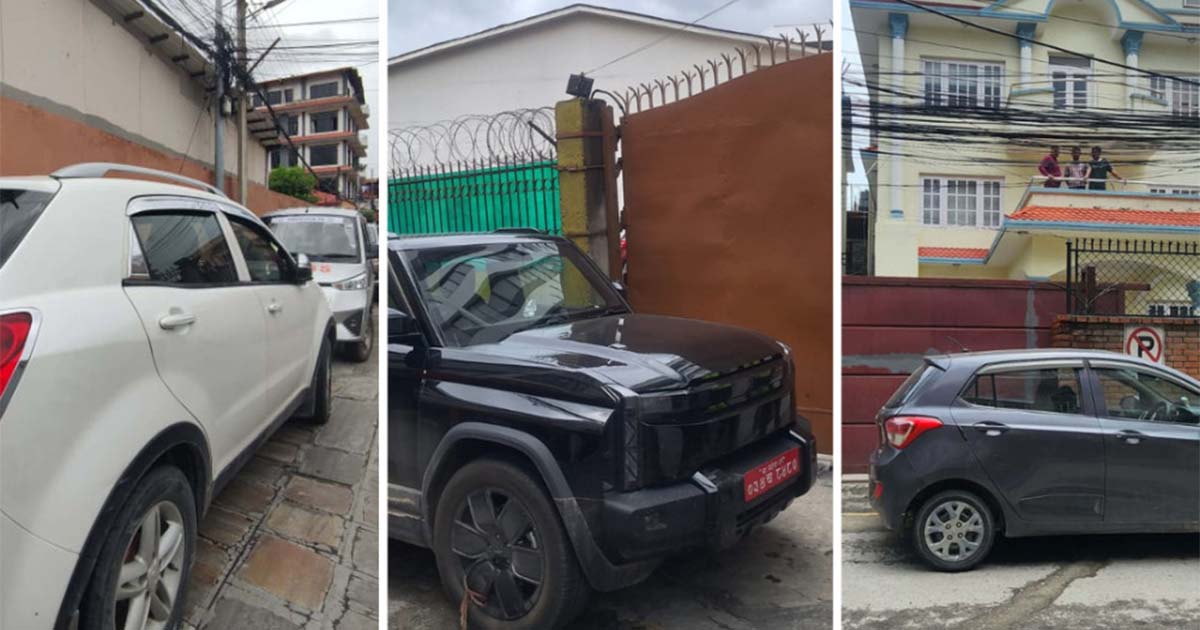
What happened in Kathmandu on the morning of Ashar 29, 2083—July 13, 2026—cannot be dismissed as a simple parking mistake. Vehicles were parked directly in front of the main entrances of Kantipur Publications, Onlinekhabar, and Himalaya Television, obstructing access to their offices.
A similar vehicle was found outside the Bhat-Bhateni Superstore in Anamnagar. A few hours later, another vehicle was reportedly parked outside Nepali Congress President Gagan Thapa’s residence in Ratopul in such a way that even motorcycles could not be taken out. Police removed the vehicles using cranes and said the incidents were under investigation.
When one vehicle is parked in the wrong place, it can be considered driver negligence. When two vehicles are parked improperly, one may still look for the possibility of coincidence. But when, on the same morning, at roughly the same time, in nearly identical fashion, vehicles are placed in front of three media houses known for publishing critical news, the residence of the main opposition party’s president, and a busy commercial establishment, it is no longer just ordinary parking.
At the very least, it is unusual. It is suspicious. Whether it was coordinated is a matter for investigation. But anyone trying to reduce it to nothing more than “cars parked in a no-parking zone” is shamelessly attempting to draw a curtain over reality.
Terror Does Not Always Require a Bomb
Terror does not always arrive in the form of an explosion, a gunshot, or arson. Blocking the entrance of someone’s office, disrupting their work, creating fear about security, and sending the message, “We can reach your doorstep,” can also be a form of psychological intimidation.
Imagine journalists arriving at work in the morning and finding an unknown vehicle blocking the gate. There is no driver. Nobody knows who brought it, why it was brought, or what might be inside. The registered owner is unwilling or unable to take responsibility. Police take time to arrive. Employees cannot enter the office. No responsible institution can treat such a situation as routine parking and simply relax.
It is fortunate that nothing dangerous was found inside the vehicles. But the absence of explosives does not automatically prove that the act of leaving the vehicles there was innocent.
Someone may leave an empty cardboard box outside your door, and later say, “It was not a bomb.” That still does not answer who placed it there, why it was placed there, or what message it was meant to send.
Therefore, the counter-question, “Was there even a bomb in the car?” is not a sign of intelligence. It is a display of irresponsibility. Public safety is based on assessing potential risk, not on reacting only after something explodes.
Why Did Suspicion Turn Toward Those in Power?
So far, no publicly available evidence proves that the government or the ruling party ordered these vehicles to be placed there. That must be stated clearly. Journalism must not make the mistake of turning suspicion into proof or accusation into a verdict.
But it is equally necessary to understand why suspicion has turned toward those in power.
In the case of the vehicle left outside Gagan Thapa’s residence, local eyewitnesses reportedly claimed that the driver left in a police vehicle. Police have said that this matter is still under investigation. Whether the eyewitness account is accurate or mistaken, why the police vehicle was there, whether the driver was taken into custody or merely given a ride—these questions still require evidence-based answers.
But once such testimony becomes public, police cannot remain silent for long by merely repeating, “The matter is under investigation.”
The vehicle found outside Kantipur was reportedly used by Ravi Jaiswal, a departmental member of the Rastriya Swatantra Party. He is also the son of Kanthamuni Prasad Kalwar, the mayor of Garuda Municipality elected from the CPN-UML. The mayor reportedly acknowledged that his son used the vehicle. Police took the vehicle under control and said an investigation was ongoing.
This does not prove that the Rastriya Swatantra Party planned the incident. The fact that a vehicle used by a party member was found at the scene does not automatically mean the party chairperson, a minister, or the government gave the order.
Criminal investigations are not conducted by looking merely at party membership. They must examine actions, communication, instructions, financial transactions, digital evidence, and chains of command.
But a vehicle used by a person formally connected to a ruling party appearing at the entrance of a media house is not an insignificant political coincidence. It demands an explanation.
Who was given the vehicle? Who drove it there? Who instructed the driver? With whom did the driver communicate before and after the incident? Was there any connection between the drivers of the other vehicles?
These questions must be answered publicly.
The vehicle placed outside Onlinekhabar was reportedly registered in the name of an eye-clinic operator. The owner reportedly said that he was not driving it and that another person had been using it. News reports further stated that the individual believed to have been driving the vehicle later called Onlinekhabar employees and used threatening and abusive language.
That fact alone weakens the argument that all the vehicles simply wandered into the wrong locations by accident.
Blocking an office entrance, refusing to answer questions, and then threatening the news organization while aggressively asking, “How does parking a vehicle make it suspicious?” does not resemble the behavior of an innocent driver who made a simple mistake.
The Troll Page Post Did Not Calm the Fire; It Poured Oil on It
After the incident, a Facebook page called “Troll Nepal” posted a message saying, in effect:
“Media houses that call it injustice when the state removes or fines vehicles parked in no-parking zones apparently had to issue statements within five or six hours when it happened to them.”
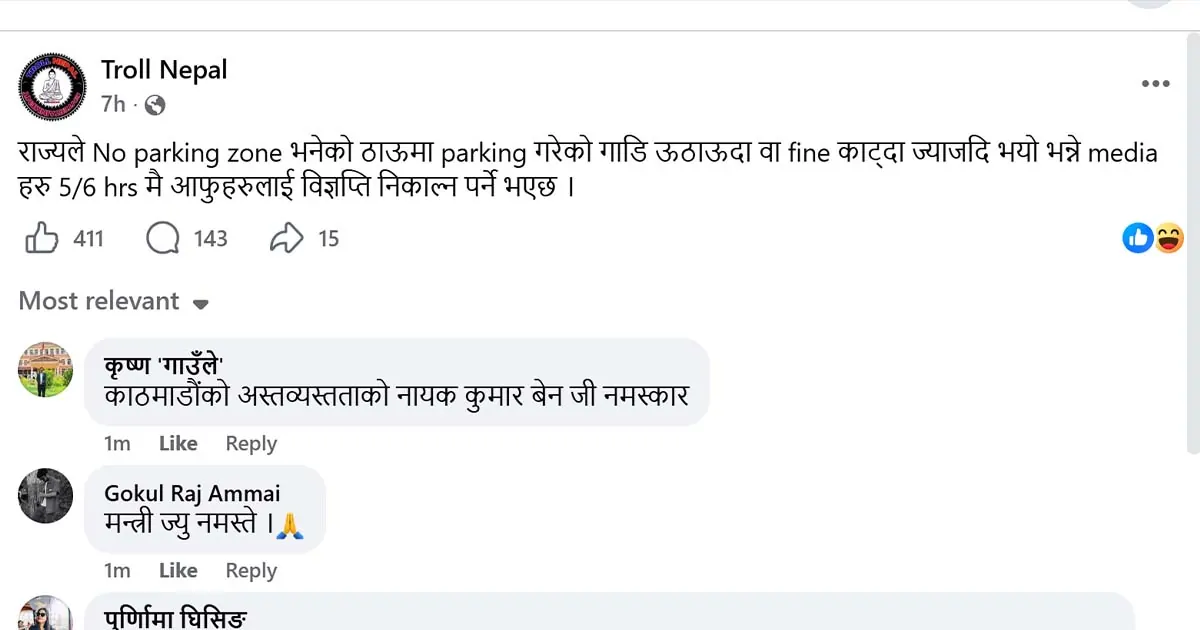
Screenshot of a Troll Nepal post from a page previously linked to Kumar Ben.
Public information has historically linked the page to Kumar Ben, also known as Kumar Byanjankar, who is now a chief adviser to Prime Minister Balendra Shah. His public professional profile has reportedly mentioned an association with Troll Nepal. His appointment as the prime minister’s chief adviser is also publicly known.
At the same time, reports have stated that he claims to have transferred control of the page after joining the government. Therefore, without evidence, it would be wrong to declare that he personally wrote or instructed the post.
But when a page historically associated with the prime minister’s chief adviser publishes such an insensitive message, suspicion naturally grows.
Instead of treating the incident as a serious security concern, a digital platform perceived as close to the government chose to mock the media. That raises legitimate questions about the democratic instincts of those surrounding power.
The post does not prove a conspiracy. But it exposes a dangerous political mindset: the tendency to view critical media as an enemy, a rival, or a group that deserves punishment.
Once you are close to power, trolling cannot become the governing philosophy of the state.
When in opposition, satire may function as a democratic weapon. Once inside Singha Durbar, the same satire can become an irresponsible display of power. When a platform connected to the prime minister’s chief adviser speaks, it is no longer perceived in the same way as the status update of an ordinary Facebook user. It sends a message about the state’s attitude.
Kumar Ben or the Prime Minister’s Office should therefore clarify: Who currently operates the page? Do any government officials retain editorial or administrative control over it? Does the post represent the government’s position or not?
Demanding this basic transparency is not opposition for the sake of opposition. It is a demand for democratic accountability.
How Dishonest Is the “No Parking” Argument?
Yes, vehicles should not be parked in no-parking zones. Vehicles that violate the rules should be towed. Fines should be imposed. The law should apply equally to everyone.
But using this argument to normalize the blocking of media-house entrances is intellectually dishonest.
Removing vehicles from no-parking zones is the responsibility of the state. Traffic police exist for that purpose. Cranes exist. Legal procedures exist.
An unknown group taking five vehicles and blocking the entrances of critical institutions is not law enforcement. It is vigilante behavior by self-appointed punishers.
If a media house criticized the municipality or the police yesterday for towing vehicles, that does not give anyone the right to block the media house’s gate today. That is not democratic accountability. It is the logic of a revenge-driven gang.
If a news report was false, issue a rebuttal. Present evidence. File a complaint with the Press Council. Go to court. File a defamation case. Hold an open debate. Question the journalist. Amend the law if necessary.
But if bringing vehicles in the middle of the night and blocking entrances is allowed to pass as “symbolic protest,” then tomorrow another group will block the gate of a hospital, a court, a school, or a private residence.
After that, every act of disorder will call itself symbolic resistance. Every threat will call itself freedom of expression. Every act of hooliganism will present itself as civic protest.
If the state does not stop this tendency now, street-level revenge will soon become the country’s alternative justice system.
The Media Is Not Washed in Milk
Opposing an attack on the media does not mean hiding the weaknesses of Nepali media.
Public criticism that many media organizations in Nepal are influenced by political parties, business groups, or financial interests is not new. Some sell propaganda instead of news. Some conduct courtroom trials through headlines. Some journalists operate according to access rather than evidence, ownership interests rather than public interest, and clicks rather than truth.
False reports have been published. Reputations have been destroyed. One-sided content has appeared. There have long been allegations that some media outlets intimidate businesses that refuse to advertise.
If anyone is bargaining in the name of journalism, demanding money to suppress news, or attacking political opponents under instructions from media owners, they too should face uncompromising legal action.
But accusations that the media is corrupt do not give anyone permission to block a media house’s gate.
Doctors can make mistakes, but that does not allow anyone to burn down a hospital. A court verdict may be unacceptable to someone, but that does not permit them to shut the courthouse. A parliamentarian may be corrupt, but that does not allow anyone to place a bomb in parliament.
Similarly, a journalist may publish something wrong, but that does not justify surrounding a media organization with anonymous vehicles and creating fear.
There are institutional mechanisms for complaints and action against unethical journalism. The Press Council of Nepal has procedures relating to journalistic codes of conduct, complaints, and action. Legal precedent has also recognized mechanisms for filing complaints over violations of professional standards.
If the law is weak, strengthen it. If institutions are ineffective, reform them.
But replacing law with abandoned vehicles, digital troll armies, and psychological intimidation is not new politics. It is merely an inexpensive version of old authoritarianism.
Press Freedom Is Not a Private Privilege of Media Owners
Article 19 of Nepal’s Constitution protects the right to communication and freedoms relating to press and publication.
This does not mean journalists have the right to do anything they want. It does not mean false reports cannot be questioned. Its central meaning is that the state or powerful groups must not use improper pressure, obstruction, or retaliation before or after publication.
Press freedom is not the private property of media owners. It is a public liberty connected to the citizen’s right to know.
When the gate of a media house is blocked, it is not only journalists who are prevented from entering their office. The road through which information reaches the public is also obstructed.
A person who applauds when the gate of a disliked media organization is blocked loses the moral right to complain tomorrow when information favorable to their own side is suppressed.
In a democracy, the media is not the government’s applause squad. Its job is not to clap during the prime minister’s speech, reproduce ministers’ Facebook posts, or function as the publicity department of the ruling party.
Its first duty is to question the government, the opposition, the courts, the army, the police, business interests, and even the media itself.
Questions can be harsh. Sometimes they can also be wrong. But the answer must come through facts, not by blocking the gate with a car.
The Ganesh Nepali Case and the Disorder in New Road: Is There a Connection, or Only Distrust?
Some social-media users have also connected this incident with the recent case of Ganesh Nepali.
Ganesh Nepali attempted self-immolation after a dispute with municipal police over parking in Tripureshwor. He later died during treatment. A committee was formed to investigate the incident, and there was reportedly an agreement to suspend the municipal police personnel who were present until the investigation report was completed.
After that, municipal police were seen less frequently on the streets, and reports and photographs emerged showing an increase in disorderly parking in areas including New Road.
The question now being raised is whether that chaotic parking was itself a planned symbolic demonstration or simply the natural consequence of municipal police temporarily withdrawing from active enforcement.
So far, there is no evidence that it was an organized protest. Therefore, directly linking the two incidents would be premature.
Connecting every coincidence with a single conspiracy is not always the search for truth. Sometimes it is merely an attempt to turn one’s own suspicion into reality.
But the government must also understand why citizens are entertaining such suspicions.
When state decisions are unclear, investigations move slowly, digital groups close to power mock serious concerns, and responsible officials remain silent, rumors fill the vacuum.
Conspiracy theories do not thrive only because citizens are foolish. They also thrive because the state is opaque.
When the government fails to provide the truth on time, every video becomes evidence, every Facebook post becomes a secret directive, and every coincidence becomes a coordinated conspiracy.
Therefore, the first method of stopping misinformation is not to silence citizens. It is for the state to provide information quickly and with evidence.
What Must the Police Do Now?
The police cannot assume their responsibility ended after towing the vehicles away.
Removing a vehicle is traffic management. Discovering the intention behind the act is criminal investigation.
Investigators must examine the real ownership of all five vehicles, their regular users, the drivers that day, mobile-location records, call details, GPS routes, CCTV footage from roads and nearby buildings, fuel-purchase records, meetings before and after the vehicles were parked, and digital communications.
If eyewitness claims that the driver outside Gagan Thapa’s residence left in a police vehicle are true, the logbook of that police vehicle should be made public.
Where was the police team deployed from? Under whose instructions did it arrive? Why was the driver taken away? If the driver was detained, where was that detention recorded? If the driver was simply given a ride, why?
Was there communication between the drivers of the vehicles? Did all of them act independently, or was there a shared instruction? Did one person arrange the money? Was there any personal dispute involving a political party, a government official, a private group, or a media organization?
The investigation must not stop with low-level drivers. If someone gave an order, it must reach the full chain of command.
If someone from the ruling party is involved, that person must be arrested. If the opposition planned the incident to discredit the government, they must not be spared either. If a media organization staged the event to gain sympathy, and evidence proves it, that too must be exposed.
Investigators must examine evidence, not party identity.
The Government’s Silence Is Itself a Problem
The incident has reportedly also been raised in the House of Representatives’ Law, Justice and Human Rights Committee. The committee chairperson claimed that the government was not involved and demanded a serious investigation and action.
But saying, “The government would never do such a thing,” is not a substitute for investigation.
If the government did not do it, the responsibility to prove that through a credible investigation also lies with the government.
The government should immediately take three steps.
First, it must publish an initial timeline of the investigation. It should explain where each vehicle came from, whether the drivers have been identified, and what evidence has been collected so far.
Second, it should publicly commit that there will be no political protection if any government official, adviser, or ruling-party figure comes within the scope of investigation.
Third, it must establish temporary but effective security arrangements for the media houses and the opposition leader’s residence.
The state cannot free itself from suspicion merely by issuing a press release denying involvement. It must conduct a fair investigation and earn public trust.
The accusation against those in power has not yet been proven. But the opportunity to demonstrate innocence is also in the hands of those in power.
If the investigation is suppressed, the drivers disappear, CCTV footage is lost, or the matter is closed with nothing more than a routine parking fine, suspicion will only deepen.
The Rastriya Swatantra Party Must Do More Than Issue a Statement
The Rastriya Swatantra Party has expressed its commitment to press freedom and freedom of expression. It has also said that activities designed to place psychological pressure on media institutions are anti-democratic. That response is welcome.
But the value of commitment is measured through conduct, not statements.
After it became public that the vehicle found outside Kantipur was used by a person holding a departmental position in the party, the Rastriya Swatantra Party should begin an internal investigation.
The individual concerned should be removed from responsibility during the investigation. The party should disclose to whom he had given the vehicle. It should actively cooperate with police rather than obstructing the process.
It is not enough to say, “He is a party member, but the party is not responsible.”
Even if the party was not institutionally involved, it has a responsibility to be transparent about the possible conduct of its member.
If a new party claims to be different from the old parties, it must also prove that difference through transparency.
If, after reaching power, it protects the mistakes of its supporters while becoming revolutionary only when opponents make mistakes, then so-called new politics is nothing more than an old shop with a new logo.
Those Who Gained Power Through the Media Must Not Treat the Media as an Enemy
Media and social media have played a major role in the rise of Nepal’s recent political forces.
Digital platforms amplified voices ignored by the old parties. Alternative leaders, independent candidates, and new political parties built their identities through television, YouTube, Facebook, TikTok, and online news portals.
Many individuals now sitting inside Singha Durbar began their political journeys on social media before they had traditional party organizations.
To forget that the same digital freedom helped them rise, and then to become intolerant of critical voices, is not merely ingratitude. It is political hypocrisy.
When social media promotes them, it is called the voice of the people. When it criticizes them, it is called anarchy. This double standard is unacceptable.
A mindset in which pages supporting the government are called patriotic, while journalists asking questions are called agents, is not democracy. It is digital feudalism.
Old rulers tried to control information from palaces. If new rulers attempt to control it through troll armies and algorithms, the method may be different, but the disease is the same.
This Is Also a Test for the Media
This incident is not only an attack on the media. It is also a test of the media’s own credibility.
Media organizations must not rush to declare those in power guilty. Publishing headlines saying “This was the government’s conspiracy” before evidence emerges would itself be irresponsible.
Eyewitness statements should be reported as eyewitness statements, not as proven facts. Political connections should be disclosed, but those connections should not automatically be presented as proof of criminal instruction.
At the same time, facts must not be hidden due to government pressure.
News must not be suppressed because of advertising, access, or political friendship. Anger over a blocked gate must not replace investigation. Mistakes should be corrected. The response of the accused side must also be published, not only the opposition’s version.
The media’s strongest weapon for protecting itself is not a slogan. It is credibility.
The day journalism becomes a party pamphlet, the moral power of press freedom weakens.
Therefore, while opposing this incident, the Nepali media must also look at its own face in the mirror.
But let it be stated again: accusations that the media is bad are not a license to threaten the media.
The Final Point: The Cars Were Removed, but the Questions Remain
The vehicles blocking the gates have been removed by cranes. But the questions they created have not been removed.
- Why were those five locations selected?
- Why on the same morning?
- Why did the drivers disappear?
- Who deployed them?
- What is the truth behind the claim that the driver outside Gagan Thapa’s house left in a police vehicle?
- What role did the Rastriya Swatantra Party member who used the vehicle outside Kantipur play?
- Who threatened Onlinekhabar?
- Was it merely a coincidence that Troll Nepal mocked the media in similar language on the same day, or did someone have prior knowledge?
Until these questions are answered, suspicion toward the government will not disappear.
But until evidence is produced, the government cannot be declared guilty either.
Neutrality does not mean sitting in the middle and insulting both sides equally. Neutrality means being willing to follow the evidence wherever it leads.
- If tomorrow’s investigation shows that someone in power was involved, this will not be a simple parking incident. It will be state-sponsored cowardice against democracy.
- If the opposition or another group planned it to frame the government, that too will be an equally vile political crime.
- If it turns out to have been a personal grudge, a cheap stunt, or symbolic protest by a citizen group, even then the method remains unacceptable: blocking public access, intimidating institutions, and abandoning vehicles while the drivers vanish.
Whoever did it, and for whatever purpose, this was not intelligence. It was not courage. It was not a movement.
It was political hooliganism.
Those in power should remember: the media does not have the right to make mistakes without consequence, but the state has even less right to intimidate.
- You cannot stop news by blocking a gate with a car.
- You cannot kill questions by mobilizing trolls.
- Police silence does not erase suspicion.
- The language of a press release does not change facts.
In a democracy, questions are not answered by shutting the door on those asking them. They are answered with facts, law, and transparency.
- Power is not permanent.
- Singha Durbar is not anyone’s ancestral property.
- The crowd applauding today may stand at the same gate with questions tomorrow.
And finally, one warning to those in power:
When milk boils too much, it does not remain inside the pot.
It spills.The arrogance of power is the same.
Lower the flame while there is still time.
Otherwise, it will not only be the spilled milk.
The hand holding the pot will burn too.

Written by Roshan Shrestha
Roshan Shrestha is a Nepali investigative journalist and founder of Khoj Samachar, covering corruption, transparency, and public-interest issues.
Why Nepal Needs an AI-Based Digital Traffic Management System
Mahabir Pun Appointed Minister of Science and Innovation in Nepal
Don’t Worship Leaders

What Nepal’s NHRC Gen Z Protest Report Reveals
Khoj Samachar Expands Multilingual Publishing With Hindi Edition
Climate Change Is Draining Oxygen From Rivers Worldwide

Summer Heat Is Rising, Follow These Simple Precautions