Sudan Gurung Meets Predatory Lending Victims in Bara
The home minister seeks direct talks in Nijgadh as marchers demand lasting action against abusive lending practices.


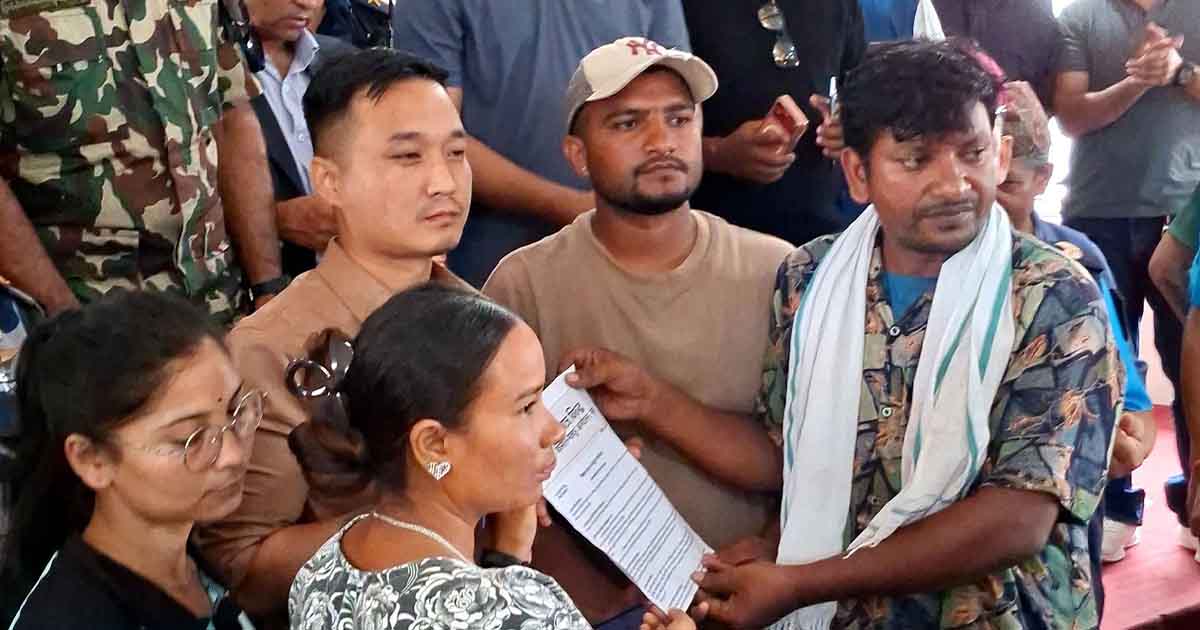
Home Minister Sudan Gurung reached Bara on Tuesday to meet victims of predatory moneylending who have been walking from Birgunj to Kathmandu, carrying the same grievances that have repeatedly brought vulnerable borrowers onto the streets.
The marchers have travelled through monsoon rain and punishing heat. Blisters have begun to form on their feet. Some do not even have umbrellas.
Gurung is expected to meet them in Nijgadh, hold direct talks and persuade them to return home with a firm government commitment to deliver justice. His decision to leave Kathmandu and meet the group before it reaches the capital deserves recognition.
The minister has already been seen reaching citizens in distress at Maitighar, Bir Hospital and a holding centre. His visit to Bara continues that approach: the state going to the aggrieved instead of waiting for exhausted citizens to arrive at its gates.
But the Nijgadh meeting will carry a heavier test. The victims have heard assurances before.
Several years ago, when Rabi Lamichhane was home minister, victims of predatory lending also came to Kathmandu to draw the government’s attention to their suffering. After a prolonged protest, Lamichhane assured them that justice would be delivered, offered them chocolates and sent them home.
The political equation changed soon afterwards. Lamichhane lost the Home Ministry and was later arrested in a cooperative fraud case.
Many of the same victims are now again walking from Birgunj towards Kathmandu.
That makes the present crisis a direct responsibility of the RSP-led government. Lamichhane’s earlier commitment cannot be treated as a forgotten promise from another political period. With the party now holding power, the government must address the problem at its roots.
The return of the victims is also evidence of an implementation failure. Nepal has already criminalised abusive lending practices and created mechanisms to examine complaints. Yet people are still being forced to walk for days simply to make the state listen.
What predatory moneylending really means
Lending money and charging a reasonable amount of interest is not, by itself, predatory moneylending.
The abuse begins when lenders exploit a borrower’s poverty, limited literacy or immediate desperation. They may prepare loan deeds showing a much larger amount than the money actually provided, add unpaid interest to the principal and charge interest again, refuse to issue receipts for repayments, obtain signatures on blank papers or cheques, or seize land and houses in the name of recovering debt.
Nepali law describes such conduct as an unfair transaction and treats it as a criminal offence rather than an ordinary private dispute.
People with weak financial conditions in rural areas are particularly vulnerable. They may urgently need money for medical treatment, their children’s education, farming, foreign employment or basic household expenses.
Banks often require proof of income, collateral, documentation and time. Those unable to meet those conditions turn to local lenders.
That is where the trap can begin.
A poor farmer may borrow Rs 100,000 but be told to place a thumbprint on a deed for Rs 200,000 or Rs 300,000 as supposed security. Some borrowers are made to sign blank papers, blank cheques or documents connected to the transfer of land.
They continue making monthly payments, but receive no receipt. Later, the lender claims that nothing was paid and demands the original amount again.
The law treats the preparation of a debt document without actually providing the loan, recording more than the amount given and refusing to acknowledge repayments as unfair transaction offences.
The interest itself can become another instrument of abuse.
A borrower taking Rs 100,000 at five per cent monthly interest would owe Rs 5,000 every month, or Rs 60,000 in interest within a year. When that amount cannot be paid, the lender may add it to the original principal and prepare a fresh deed for Rs 160,000. Interest then begins accumulating on the new figure.
Using this method, a loan of Rs 100,000 can be shown on paper as Rs 500,000 or Rs 700,000 within a few years.
Under Nepal’s Civil Code, interest charged through a private household loan document cannot exceed 10 per cent of the principal annually. The Criminal Code also treats charging interest beyond the principal and adding interest to the principal through a new document as offences.
The financial burden eventually turns into social and psychological suffering.
Borrowers may face abuse at home, threats against family members, fear of physical assault, public humiliation or pressure to abandon their property. In some cases, they continue paying well beyond the principal and lawful interest, yet the debt never ends.
The law also criminalises threats, violence and exploitation used in the name of debt recovery, along with the transfer of a borrower’s immovable property through an unfair transaction.
The scale of the crisis
Government figures have already shown that this is not a dispute involving a handful of borrowers and lenders.
The commission formed to investigate unfair transactions said nearly 24,000 complaints had been filed across the country by the end of Asar 2080.
Of those, 18,356 complaints came from the eight districts of Madhesh Province. Another 1,889 were filed in West Nawalparasi.
Bara recorded the highest number, with 3,322 complaints.
During roughly the first one and a half months of its work, the commission settled around 2,000 complaints through mediation. In those settlements, lenders agreed to abandon more than Rs 1.14 billion from the amounts they had demanded. More than 41 bighas of land were also returned to borrowers.
Those outcomes show that the dispute is not merely about high interest. It often involves inflated documents, unrecorded repayments and property taken through unequal bargaining power.
Justice does not mean cancelling every loan
Solving the problem does not mean automatically waiving all private debt.
A person who genuinely borrowed Rs 100,000 remains responsible for paying the verified principal and the interest permitted by law.
The injustice lies in lending Rs 100,000 but preparing documents for Rs 500,000, denying money already repaid, producing fabricated calculations or taking property worth far more than the debt.
The commission’s settlements followed the same principle. Actual transactions were examined. Some borrowers paid verified amounts, some debts were declared settled, and land taken through abusive arrangements was returned.
Justice, therefore, is not about giving borrowers free money. It is about separating genuine debt from exploitation and returning money or property taken unlawfully.
The law allows punishment of up to seven years in prison and a fine of up to Rs 70,000, depending on the seriousness of the offence.
It also permits authorities to separate the actual principal and lawful interest from money or property obtained through an unfair transaction. The remaining amount or property can be returned to the victim. An unlawful transfer of immovable property can also be cancelled.
Assurances must now become enforceable action
Sending the marchers home after another promise will not be enough.
Every loan deed, cheque, bank transaction and land-registration document must be examined. Authorities must calculate how much each borrower actually received, how much has already been repaid and whether the lender’s demand is lawful.
Property seized through abusive transactions must be returned. Cases must be filed against offenders where criminal conduct is established.
The government must also ensure that victims do not have to begin another march after the next change in political power.
Gurung’s decision to meet them in Nijgadh may prevent further physical suffering on the road. Its real value, however, will be measured by what follows: verified accounts, restored property, prosecuted offenders and justice that survives beyond a minister’s assurance.

Written by Pushpa Tamang
Pushpa Tamang is Managing Editor at Khoj Samachar, leading English and Nepali bureaus, newsroom operations, and editorial standards.
Nagarik App Now Shows Blood Stocks Across Nepal
Sudan Gurung Makes Citizens Feel the State Is Present
Hetauda Textile Industry Set to Reopen
Ghorahi Ward Member Arrested Over Engine Oil Attack
Rasuwagadhi Hydropower Stops Power Generation as Rivers Rise
Five Year Old Boy Dies in Dhorpatan Wall Collapse
Ekmaya Nepali Receives Citizenship After Ganesh’s Death