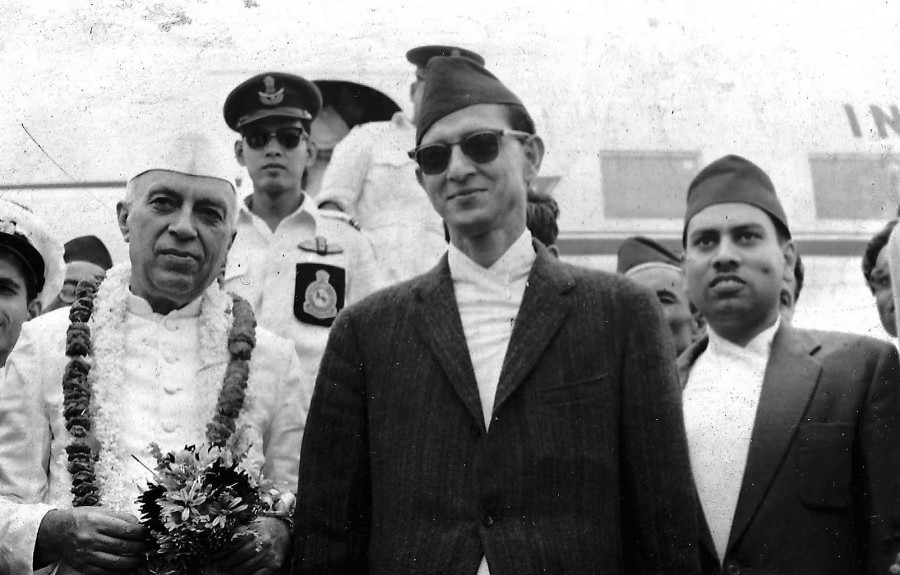
Nepal is observing National Reconciliation Day on Monday to commemorate the historic return of the country’s first democratically elected prime minister, B.P. Koirala, who chose national unity over personal safety despite facing multiple death penalty charges.
At the time of his return, eight capital punishment cases were pending against Koirala in court. Nonetheless, he returned to Nepal prepared to sacrifice his life for the country’s sovereignty, unity, and democratic future.
On Poush 16, 2033 BS (December 30, 1976), Koirala—also the founding leader of the Nepali Congress—returned to Nepal from exile after nearly eight years. He was accompanied by senior party leaders and activists, including Ganesh Man Singh, Shailaja Acharya, Khum Bahadur Khadka, Ram Babu Prasai, Nilambar Panthi, and others.
Context Behind the National Reconciliation Policy
During their exile in India, Koirala and his colleagues closely observed major regional developments, including the merger of Sikkim into India, the separation of Pakistan, and growing fragmentation in several Asian countries. These events raised concerns that Nepal’s national unity could weaken amid prolonged internal political conflict.
In response, the leaders adopted the policy of national unity and reconciliation, returning to Nepal 49 years ago with the aim of strengthening national cohesion and safeguarding sovereignty.
Despite the reconciliation initiative, Koirala and other leaders were arrested immediately upon landing at Tribhuvan International Airport and taken to the Sundarijal detention center, where they were imprisoned once again.
Koirala’s imprisonment dated back to the royal coup of Poush 1, 2017 BS (December 15, 1960) by then King Mahendra, following which he was detained inside Singha Durbar for nearly three months. Later that year, on Falgun 26, he was transferred to a specially secured prison at Sundarijal, enclosed by walls and guarded by the Nepali Army.
Detention, Release, and Literary Contributions
After eight years in detention, Koirala was released in 2025 BS for medical treatment and allowed to travel to India, where he resumed political activities against the autocratic Panchayat system.
Even after his return under the reconciliation policy, Koirala’s imprisonment continued. On Jestha 27, 2034 BS, he was temporarily released with the condition that he would return to prison following medical treatment. He was later detained again at Sundarijal and subsequently transferred to the Police Training Center in Maharajgunj.
The detention facility, covering 24 ropanis of land, was converted into the B.P. Koirala Museum on Bhadra 24, 2061 BS, preserving a critical chapter of Nepal’s democratic history.
While in detention at Sundarijal, Koirala authored several landmark works of Nepali literature, including the short story collection Shwetabhairavi and novels such as Sumnima, Teen Ghumti, Modiain, and Hitler and the Jews. He also wrote his autobiography Atmakatha and a prison diary later published as Jail Journal.
Another diary written after his re-arrest following the 2033 reconciliation return was later published under the title Phiri Sundarijal (Back to Sundarijal). Prior to his imprisonment, Koirala had published the short story collection Doshi Chashma in 2008 BS, establishing him as a pioneer of the psycho-sexual narrative tradition in Nepali fiction.
Nationwide Observance and Reflection
On the occasion of National Reconciliation Day, the Nepali Congress and its sister organizations are holding various programs across the country. The B.P. Koirala Museum has also announced commemorative events.
However, observers have often noted that the annual observance of Poush 16 risks becoming ceremonial, rather than serving as a meaningful reflection on the principles of unity and reconciliation envisioned by Koirala.