Nepal’s Total Public Debt Reaches Rs. 29.4 Trillion in 2026
Nepal’s total public debt has climbed to nearly Rs. 29.4 trillion in 2026 after the new government borrowed almost Rs. 49 billion in 40 days.


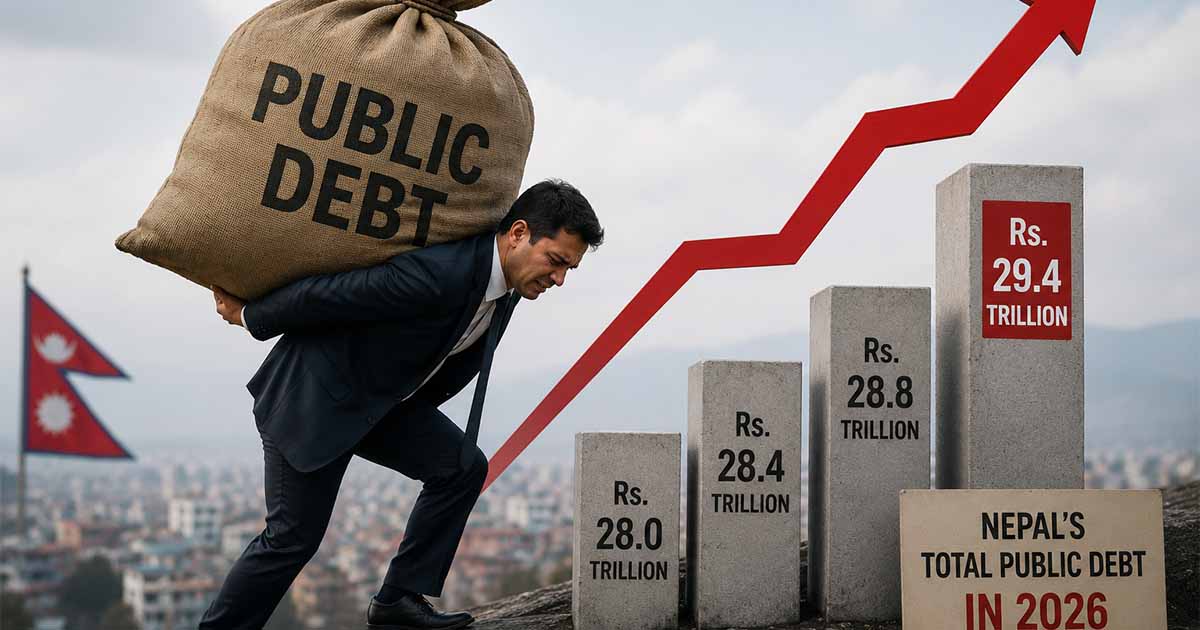
The rapid rise in Nepal’s public debt has once again become a major topic of national discussion after the new government borrowed nearly Rs. 49 billion within just 40 days of taking office. The loans, approved under multiple development-related projects, have added fresh pressure to the country’s already growing financial burden, with Nepal’s total public debt now reaching nearly Rs. 29.4 trillion.
The issue has triggered debate over whether foreign loans are helping Nepal move toward economic growth or pushing the country toward a dangerous debt cycle. Economists and policy observers say borrowing itself is not necessarily harmful, but the real concern lies in how the money is being spent and whether it is creating long-term economic returns.
The latest borrowing decisions have also revived comparisons with countries that successfully transformed their economies through strategic use of foreign loans, as well as nations that faced severe financial crises after failing to manage debt responsibly.
Government Borrows Over Rs. 48 Billion in 40 Days
The government approved several major foreign loans shortly after assuming office. According to details discussed in the video script, the borrowing process began on Chaitra 23, 2082, when the Cabinet meeting approved 185 million US dollars in loans.
The amount included:
- 90 million US dollars for Digital Nepal Transformation
- 95 million US dollars for sustainable and inclusive finance programs
The total amount from this decision alone was estimated at around Rs. 28 billion.
Just two days later, another Cabinet meeting on Chaitra 25 approved an additional 85 million US dollars in foreign loans for the Lumbini Development Project, equivalent to nearly Rs. 13 billion.
The borrowing continued again on Baisakh 21, 2083, when the government approved another 52 million US dollars for industrial reform and air quality improvement projects. The amount was estimated at around Rs. 7.9 billion.
Combined together, the new government borrowed nearly 322 million US dollars within 40 days, equivalent to approximately Rs. 48.96 billion based on current exchange rates.
Nepal’s Total Public Debt Reaches Rs. 29.4 Trillion
With the latest loans included, Nepal’s total public debt has reached around Rs. 29.4 trillion. When divided by the country’s population, the burden stands at nearly Rs. 99,220 per citizen.
This means that every newborn child in Nepal is effectively entering the world carrying close to Rs. 1 lakh in national debt.
The growing debt figure has raised concerns over how Nepal will continue managing repayment obligations in the coming years, especially as a significant portion of state revenue is already being used to repay older loans and interest.
Observers say Nepal’s current challenge is not simply the size of the debt but the country’s increasing dependence on new loans to manage existing financial liabilities.
Why Foreign Loans Are Not Always Negative
The discussion surrounding Nepal’s debt has also highlighted an important global reality: almost every country in the world relies on loans at some point during economic development.
Several countries successfully used foreign borrowing to transform weak economies into global financial powers.
One major example often cited is South Korea. Around 70 years ago, South Korea was among the poorest countries in the world and had suffered severe destruction from war. During the 1960s and 1970s, the country took billions of dollars in loans from nations including the United States and Japan.
Instead of using the borrowed money for administrative expenses or salary payments, South Korea invested heavily in productive sectors such as:
- Steel industries
- Shipbuilding factories
- Road infrastructure
- Technical education
Those investments eventually helped create global companies like Samsung and Hyundai, turning South Korea into one of the world’s leading industrial economies.
By 2001, South Korea had fully repaid its international loans and emerged as one of the world’s top economies.
Another frequently discussed example is Israel. After its establishment in 1948, Israel lacked agricultural land and natural resources while facing constant regional conflict. The country relied heavily on foreign support and international loans during its early years.
However, Israel focused its investments on technology, research, irrigation systems, cybersecurity, software development, and medical science. The country later became globally recognized as a major technology and startup hub.
Analysts say these examples demonstrate that foreign loans can support long-term growth when used strategically in productive sectors.
Concerns Over Nepal’s Spending Priorities
Critics argue that Nepal has failed to use foreign loans in the same productive manner seen in successful economies.
According to claims raised in the discussion, nearly 65 percent of Nepal’s revenue collection and borrowed funds are currently being spent on administrative expenses such as:
- Government salaries
- Allowances
- Operational costs
Another 20 to 25 percent is reportedly being used to repay previous loans and interest payments.
This leaves only around 10 to 15 percent of total spending available for development projects and infrastructure work.
Questions have also been raised about corruption and financial irregularities in several large projects. The script references allegations connected to projects such as the Pokhara International Airport, wide-body aircraft procurement, and the Teramocs system purchase.
Critics argue that weak implementation, corruption allegations, and poor long-term planning have reduced the effectiveness of development spending in Nepal.
Lessons From Sri Lanka’s Financial Crisis
The debate over Nepal’s growing debt has also led many to compare the situation with Sri Lanka, which faced a major economic crisis in 2022.
Sri Lanka borrowed billions of dollars from China and other countries to build large infrastructure projects including ports and airports. However, many of those projects failed to generate sufficient revenue to cover repayment obligations.
At the same time, policy decisions such as tax cuts and restrictions on chemical fertilizers weakened government income and agricultural production.
The country later faced a severe shortage of foreign currency reserves, making it difficult to import fuel, medicine, and other essential goods.
The crisis eventually triggered nationwide protests, political instability, and economic collapse. Sri Lanka officially declared bankruptcy in 2022 and continues to struggle with debt restructuring under international financial conditions.
The script also mentions countries such as Pakistan, Argentina, and Ghana as examples of nations facing financial difficulties linked to debt management challenges.
Nepal’s Economic Future Depends on Loan Utilization
Experts say Nepal still has the opportunity to use foreign borrowing as a tool for economic transformation if future investments focus on productive sectors, infrastructure, industry, technology, and employment generation.
The ongoing debate reflects two different possibilities for Nepal’s future. One path could follow the development-focused models of South Korea and Israel, where loans became investment capital for long-term growth. The other path could mirror countries that faced severe crises after poor financial management and unsustainable debt practices.
The discussion ultimately highlights a broader national concern about governance, accountability, and economic planning.
Many observers argue that borrowing money is not automatically a problem for a developing nation. However, failing to use those resources effectively may create long-term financial risks that future generations will eventually have to bear.


Written by Roshan Shrestha
Roshan Shrestha is a Nepali investigative journalist and founder of Khoj Samachar, covering corruption, transparency, and public-interest issues.
Arzu Rana and the Passport Scandal Explained: Inside Nepal’s E-Passport Probe

Janakpur Dham Waste Management Crisis Raises Public Concern

Sudan Gurung Reopens Nepal’s Palace Massacre Debate After 24 Years
Nepal Budget Debate: Debt, Taxes and Spending

What Nepal’s NHRC Gen Z Protest Report Reveals

What Is MoFA Mitra App and How to Use It?

Deuba Couple Case: Supreme Court Cancels Arrest Warrant