Young Doctors Demand Legal Limits on Hospital Duty Hours
Interns and resident doctors demand legal duty limits, weekly leave, overtime pay and implementation of agreed salaries.


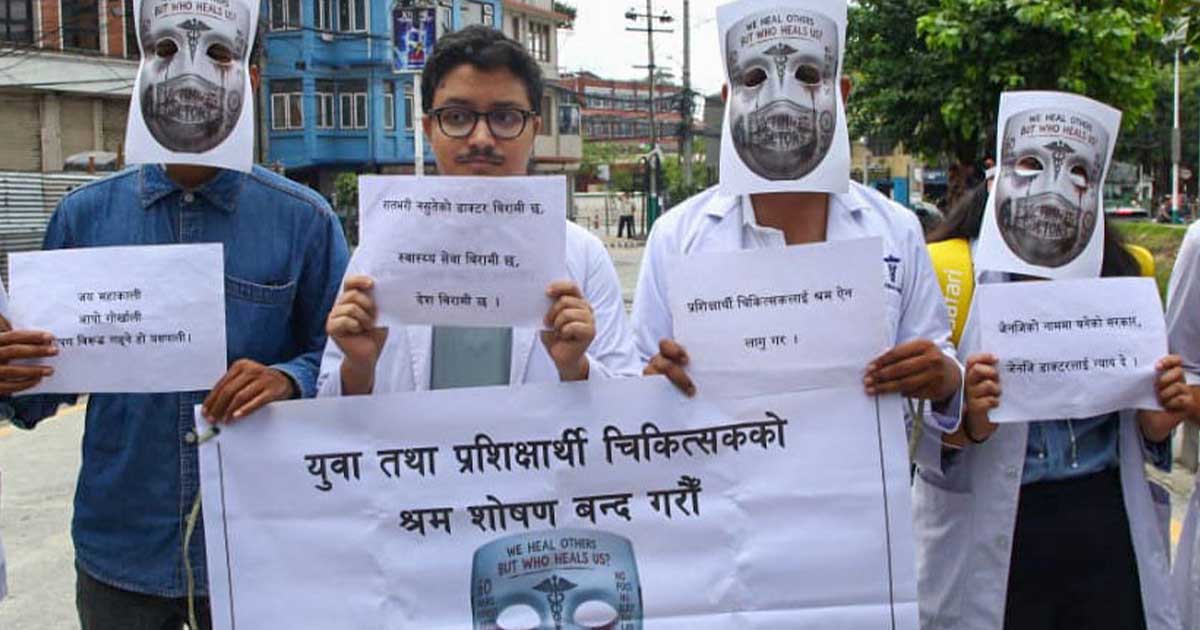
Young doctors treating patients while completing their own medical training have taken their grievances outside hospital walls, protesting what they describe as excessive workloads, unpaid extra hours and the routine denial of rest.
Interns, medical officers and resident doctors from different hospitals gathered at Maitighar in Kathmandu on Saturday, demanding legally regulated working hours and an end to labour exploitation carried out in the name of medical training.
The protest brings attention to a difficult line inside teaching hospitals: where clinical training ends and underpaid labour begins. For the doctors involved, the issue is not confined to salaries or workplace benefits. Long, uninterrupted shifts also affect judgement, patient safety and the quality of care delivered inside already demanding hospital environments.
Doctors demand limits on continuous duty
The protesters have formed the Struggle Committee Against Labour Exploitation of Young and Trainee Doctors to organise the movement.
They said interns and resident doctors are frequently required to remain on duty for extended periods without regular weekly leave. Many are also made to work beyond normal hours without receiving additional payment.
The committee has demanded that the duty schedules of trainee doctors be brought under the Labour Act, 2017.
Its key demands include:
- A maximum duty period of 12 hours a day.
- No more than 72 working hours in a week.
- At least one compulsory day off every week.
- Overtime payment when doctors are required to work beyond 48 hours a week.
The doctors said medical education cannot be used to justify prolonged work without adequate rest or fair compensation. Training requires responsibility and service, they argued, but those responsibilities should not remove basic labour protections.
Salary agreements remain unimplemented
Resident doctors also raised the government’s failure to implement previous agreements concerning their salaries.
They demanded payment equivalent to the revised salary of an eighth-level government officer, in line with earlier commitments and the increase announced through the national budget.
The salary dispute has remained unresolved even as resident doctors continue to carry major clinical responsibilities in hospitals. Their work includes patient care as well as the academic requirements of postgraduate medical training.
The protesters said the existing arrangement places young doctors under pressure from both sides. They are treated as trainees when pay and workplace rights are discussed, but expected to carry the workload of full-time medical staff while on duty.
Opposition to mandatory work experience rule
The doctors also opposed the provision requiring one year of compulsory work experience after completing MBBS or BDS before entering postgraduate programmes such as MD, MS or MDS.
They demanded that the requirement be removed.
For young doctors, the provision adds another compulsory stage before specialist training at a time when many are already working in conditions they consider poorly regulated.
The movement has therefore brought together concerns that are often handled separately: hospital duty hours, overtime payment, resident salaries and the structure of postgraduate medical education.
A question of dignity and patient care
The protesting doctors said unclear boundaries between training, service and labour have left young medical professionals under serious physical and mental pressure.
They called on the concerned authorities to improve working conditions and ensure that hospitals follow lawful duty schedules.
Their message at Maitighar was direct. This is not only a dispute over pay.
The doctors have framed the movement as a struggle for professional dignity, safe medical practice and a health system that does not depend on exhausted trainees working without proper rest, leave or compensation.

Written by Pushpa Tamang
Pushpa Tamang is Managing Editor at Khoj Samachar, leading English and Nepali bureaus, newsroom operations, and editorial standards.
Heavy Monsoon Rain Puts Nepal on Alert
Health Minister Mehta Promises Better Healthcare for Minorities
National ID Now Required for Old Bank Accounts in Nepal
Saptakoshi Flood Rises, 21 Koshi Barrage Gates Opened
Why Are Protests Spreading Everywhere Across Nepal Right Now?
Farmers Take Tomatoes to the Streets as Prices Crash

Nepal Rastra Bank Sets US Dollar Selling Rate at Rs 154.23