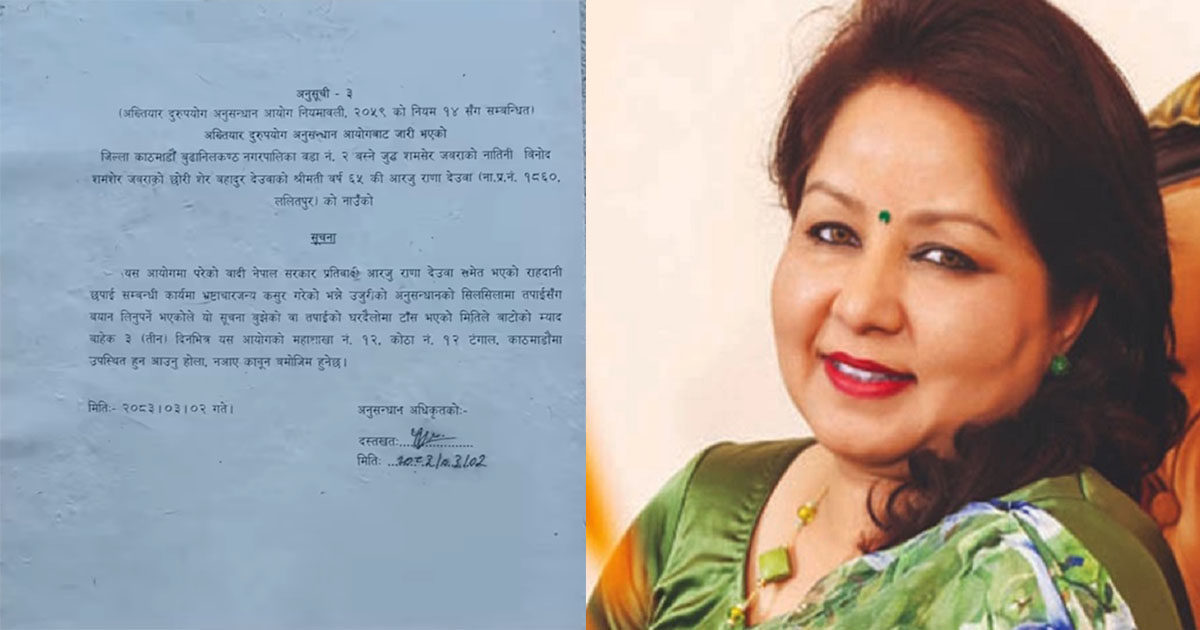
A public notice pasted outside the residence of former Foreign Minister Arzu Rana has pushed Nepal’s passport printing controversy back into the national spotlight. The Commission for the Investigation of Abuse of Authority (CIAA) has asked Rana to appear within three days to record her statement in connection with an ongoing investigation into alleged irregularities in the country’s e-passport procurement process.
Until a few months ago, Rana was considered one of Nepal’s most influential political figures. She has been living abroad while facing the possibility of investigations in multiple cases. The decision to publicly summon her through a notice attached outside her residence has intensified attention on the passport procurement dispute and the wider political battle surrounding it.
The CIAA is currently investigating allegations that irregularities may have occurred during the procurement of Nepal’s new electronic passports. Several senior officials have already been arrested. Political discussions have increasingly focused on whether the investigation could eventually reach former Prime Minister KP Sharma Oli and former Foreign Minister Arzu Rana, who were in office when the contract was awarded.
The investigation, however, has become controversial for another reason. Allegations that the Prime Minister’s Office pressured anti-corruption officials and pushed for arrest warrants have triggered debate inside Parliament and across the media.
How the Passport Contract Changed Hands
For nearly 15 years, Nepal relied on the French company IDEMIA to print its passports. During that period, the company produced more than 15 million Nepali passports.
After the company’s contract expired in November 2024, the government announced a new tender for the printing of 6.4 million electronic passports and the installation of the associated system.
This time, the French company lost the bid.
Instead, the government awarded two separate packages to German firms.
- Veridos GmbH received a contract worth Rs 6.11 billion.
- Mühlbauer ID Services GmbH received a contract worth Rs 1.55 billion.
- The combined value of the five-year agreement reached Rs 7.66 billion.
The decision immediately drew objections from IDEMIA.
The French company argued that officials within the Department of Passports had manipulated tender conditions to ensure that the German companies qualified while rival bidders were excluded. It also alleged that the winning companies lacked the required technical qualifications and that corruption worth more than Rs 1 billion had occurred during the procurement process.
IDEMIA challenged the decision before Nepal’s Public Procurement Review Committee. The committee rejected the company’s claims. The dispute then moved to the Supreme Court.
Separate petitions were filed by IDEMIA and advocate Kusum Kishor Koirala. While the French company challenged the legality of the procurement process itself, Koirala argued that passport printing, because of its connection to national security, should be entrusted to Nepal’s own Security Printing Centre rather than a foreign private company.
Both petitioners sought an interim order to halt the contract. In July 2025, the Supreme Court declined to issue a stay order, allowing the procurement process to continue. Had the court intervened at that stage, the contract could have been suspended immediately.
From Procurement Dispute to Anti-Corruption Investigation
After failing before the review committee and the Supreme Court, IDEMIA approached the CIAA alleging large-scale and policy-level corruption in the passport procurement process.
The anti-graft body did not immediately take aggressive action.
The matter was complicated by the fact that major public procurement decisions often involve consultations with the CIAA before contracts are finalized. The passport tender had also gone through discussions with the commission, and the procurement process was reportedly advanced after receiving positive feedback.
As a result, the complaint placed the anti-corruption agency in a difficult position.
Despite complaints before multiple institutions, the French company remained dissatisfied with the outcome.
Then Nepal’s political landscape changed dramatically.
The Gen-Z movement reshaped national politics, leading to the formation of a Rastriya Swatantra Party-led government with 182 parliamentary seats and Balen becoming Prime Minister.
During that period, former Prime Minister KP Sharma Oli and Ramesh Lekhak were arrested and held in custody for 13 days over their alleged responsibility in the violence and crackdown that occurred on Bhadra 23 during the movement.
No court case has yet been filed against them.
The government also sought arrest warrants against Sher Bahadur Deuba and Arzu Rana in a money laundering case and requested an Interpol Red Notice. Interpol declined to issue the notice, stating that sufficient evidence had not been presented.
As criticism mounted over the government’s inability to take major political figures to court, the passport procurement case returned to the forefront.
Why the Prime Minister’s Office Is Under Scrutiny
The latest controversy is no longer limited to the passport contract itself.
The complaint submitted over the passport procurement reached the Prime Minister’s Office. The significance of the complaint was that it directly related to a contract signed when KP Sharma Oli was Prime Minister and Arzu Rana was Foreign Minister.
A deeper investigation could potentially examine decisions taken at the highest political level. Following this, senior officials of the CIAA were summoned to the Prime Minister’s Office.
Those called included CIAA Chief Commissioner Prem Rai, commissioners Jay Bahadur Chand, Hari Paudel and Sumitra Shrestha Amatya, along with the commission secretary and several investigating officers.
They were reportedly kept at the Prime Minister’s Office for around nine hours.
During that time, members of the Prime Minister’s Secretariat allegedly questioned why the passport case had not moved forward and pressed for immediate arrests.
Media reports have stated that arrest warrants were prepared inside the Prime Minister’s Office itself. Foreign Secretary Amrit Rai, Department of Passports Director General Tirtha Raj Aryal and IT Director Sunil KC were later arrested after being called to another room in the same building.
The Larger Constitutional Question
What has made the issue politically significant is not only the passport investigation but the constitutional principle involved.
The CIAA is not a department that operates under the direct authority of the Prime Minister. Unlike the police, the Central Investigation Bureau or other executive agencies, the anti-graft commission was established as an independent constitutional body designed to investigate corruption within the state itself.
Its purpose is to provide institutional checks on governments, public officials and state agencies.
In practical terms, the CIAA has the authority to investigate even a sitting Prime Minister if circumstances require.
That is why the allegation that officials from the Prime Minister’s Office summoned anti-corruption commissioners, questioned them about an active case and pushed for arrests has become a major political issue.
Parliamentary discussions over the past two days have focused heavily on this question.
The concern extends beyond the passport case. If an independent constitutional body can be pressured or directed by the executive branch during an active investigation, the broader system of accountability could be weakened.
For many lawmakers and legal observers, the debate is ultimately about the future independence of institutions tasked with investigating corruption within government itself.
What Happens Next?
The CIAA has already posted a notice outside Arzu Rana’s residence directing her to appear within three days for questioning. Investigators appear determined to move the case forward at a rapid pace.
Whether the inquiry eventually reaches senior political figures, whether criminal charges emerge, and whether the constitutional questions surrounding the Prime Minister’s Office deepen further will become clearer in the coming weeks.
Another issue is also being closely watched. If Rana fails to appear before investigators within the specified period, discussions have already begun over whether the government could once again seek international assistance and make another attempt to pursue an Interpol Red Notice.
The passport procurement dispute began as a fight over a multi-billion-rupee contract. It has now evolved into a test of institutional independence, political accountability and the limits of executive influence over Nepal’s constitutional watchdogs.