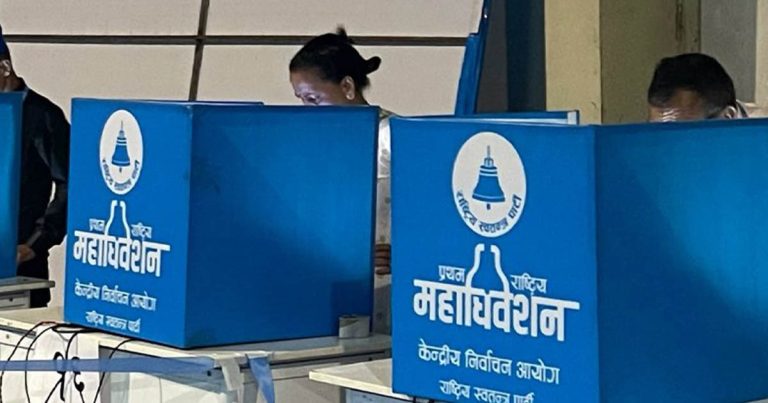
Gagan Thapa Warns Government Against ‘Arrogance of Numbers’
Nepali Congress president questions evictions, arrests, constitutional amendment talks and the government’s handling of rising public hardship.


Nepali Congress President Gagan Thapa has warned the ruling side against what he called the “arrogance of numbers,” saying a government with a strong majority carries a greater responsibility to remain accountable, restrained and constitutionally disciplined.
Speaking at a party event in Sunsari, Thapa accused the current power structure of increasingly using its numerical strength to pressure constitutional boundaries, civil liberties and legal processes. He said Nepal has already witnessed governments with comfortable majorities fail before completing their tenure, and argued that public accountability matters more than political power itself.
He also took aim at Prime Minister Balen Shah, urging him to understand the difference between public popularity and constitutional authority.
“No one stands above the constitution and the law,” Thapa said. “Being popular does not give anyone the right to do whatever they want.”
Questions Raised Over Evictions and Arrests
Thapa criticised the government’s ongoing drive to remove informal settlements, saying demolitions without a clear rehabilitation or management plan were unacceptable. He said the state has the authority to clear encroachments, but such actions must follow legal procedure and human sensitivity.
He also accused the government of arbitrarily targeting industrialists, businesspeople and banking sector officials. Referring to recent arrests, Thapa claimed construction entrepreneurs were detained after being denied access to ministers, while even chief executives of banks had been taken into custody in ways that created fear and uncertainty in the business community.
If unlawful actions continue, he warned, the Nepali Congress would launch protests.
Rising Cost of Living and Public Frustration
A large part of Thapa’s speech focused on the growing economic pressure faced by ordinary citizens.
He said tensions in the Middle East have already pushed fuel prices upward, increasing transportation costs and making daily essentials more expensive. Farmers, he added, are struggling under rising irrigation expenses while the fertilizer shortage remains unresolved.
Thapa also accused the government of turning the cooperative crisis into a publicity campaign instead of addressing the actual scale of public losses. He argued that while nearly Rs 100 billion needs to be returned to victims, the government is projecting small disbursements as major achievements.
He said the national health insurance program has become disorganised and criticised restrictions imposed on goods worth over Rs 100 in border areas, saying the policy has created unnecessary hardship for local residents.
Concerns Over Constitutional Amendment Process
Thapa appeared dissatisfied with the task force formed to discuss constitutional amendment proposals. He warned against treating constitutional reform as a political game and described the 2015 Constitution as a document closely tied to the emotions and struggles of the Nepali people.
According to him, constitutional amendment cannot be decided through closed-door discussions among a handful of individuals.
He also demanded an impartial investigation into the incident of Bhadra 24 linked to the Gen-Z movement, saying the event caused significant human and property damage. Thapa urged the government to make public the report prepared by the National Human Rights Commission.
Challenge Over Wealth Investigation
Moving into the debate around governance and accountability, Thapa said the jurisdiction and authority of the commission formed to investigate the assets of public office holders must be made clear.
“If I have done something wrong, I am ready to face examination,” he said. “Are the Prime Minister and ministers ready as well?”
He argued that the public has the right to question ministers about their property disclosures and the legitimacy of their sources of wealth.

Written by Roshani Shrestha Pathak
Roshani Shrestha Pathak is the English Bureau Chief at Khoj Samachar, overseeing English-language editorial operations and newsroom coordination.
Why Did an RSP MP Recall Kulman Ghising in Parliament?
Prime Minister’s Office Like Hitler’s Gas Chamber: Lawmaker
Speaker Aryal: Learn Parliament, Not Your Phone
Four Former PMs Share Stage at Madan Bhandari Event
Prachanda Urges Left Unity at Bhandari Anniversary
Ramji Yadav Faces Scrutiny After Party Election Loss
RSP Elects Rabi, Swarnim, Sobita and Bipin to Top Posts