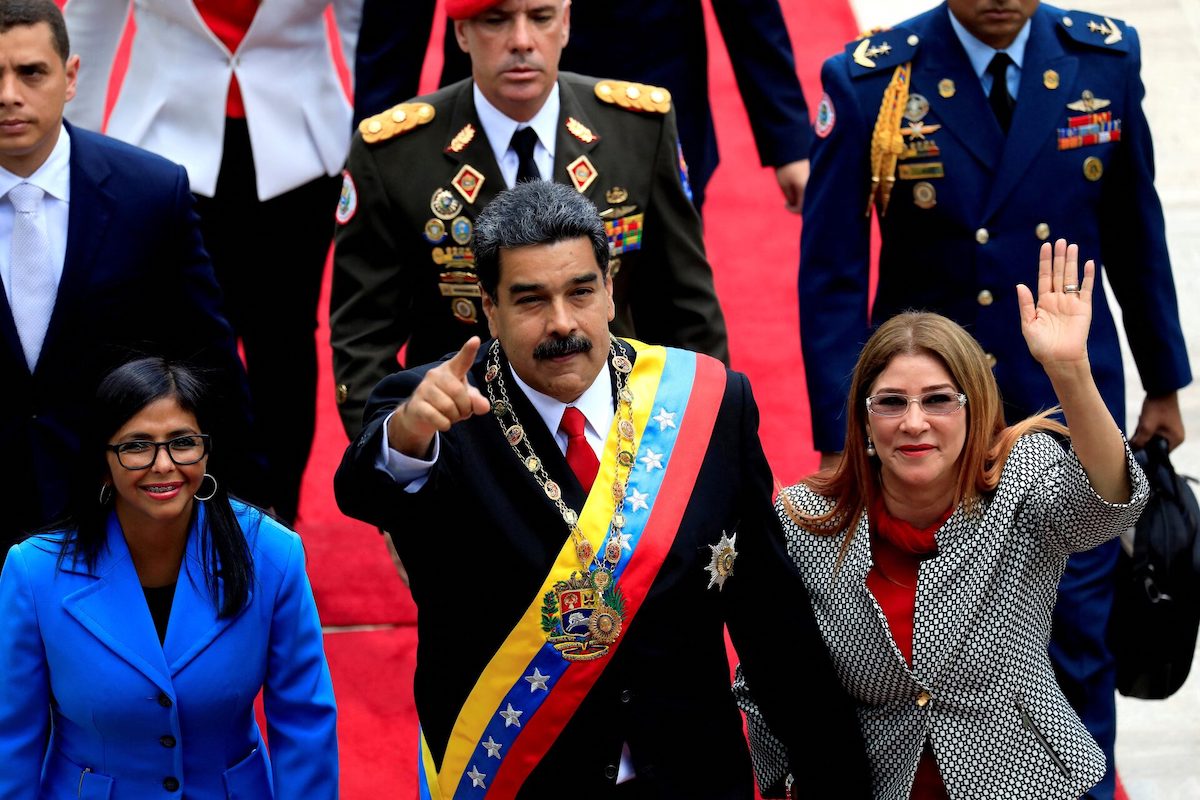
Questions are mounting over who is effectively running oil-rich Venezuela after the United States detained President Nicolas Maduro, an action described by US President Donald Trump as “surprising and powerful.”
Trump claimed on Saturday that Venezuelan Vice President Delcy Rodríguez was sworn in following Maduro’s detention and that she had held talks with US Secretary of State Marco Rubio. His remarks fueled speculation that Rodríguez had assumed control of the country’s leadership.
Under Venezuela’s constitution, Rodríguez would become acting president in the event of Maduro’s absence. The country’s Supreme Court reportedly endorsed this constitutional process late Saturday night.
However, shortly after Trump’s statement, Rodríguez appeared on state television. Standing alongside National Assembly Speaker and her brother Jorge Rodríguez, Interior Minister Diosdado Cabello, and Defense Minister Vladimir Padrino López, she reiterated that Maduro remains Venezuela’s sole legitimate president.
Analysts say the joint appearance signaled that the power bloc governing alongside Maduro remains united. Meanwhile, Trump on Saturday dismissed the possibility of cooperation with opposition leader and Nobel Prize laureate María Corina Machado, stating that she lacks sufficient domestic support.
Machado was barred from contesting the 2024 election. Although international observers reported that her proxy candidate won by a large margin, Maduro’s government declared victory for itself.
According to analysts, real power in Venezuela has for more than a decade been concentrated within a small circle of senior officials. This system is based on loyal networks, security forces, corruption, and surveillance.
Within this internal power structure, a balance is maintained between civilian and military factions. The Rodríguez siblings represent the civilian wing, while Padrino and Cabello are considered the most powerful figures within the military establishment.
Because of this structure, US and Venezuelan analysts argue that dismantling the current system by removing Maduro alone would be extremely difficult.
“The more pieces of the government you remove, the more individuals at different levels must also be removed to bring about real change,” said a former US official involved in criminal investigations related to Venezuela.
Particular attention has focused on Cabello, who is widely regarded as exerting influence over both military and civilian intelligence agencies. “Cabello is the most ideological, violent, and unpredictable figure,” said Venezuelan military strategist José García.
Cabello is a former military officer and a powerful leader within the ruling Socialist Party. Although the armed forces are formally under the authority of Defense Minister Padrino, Cabello is believed to wield significant influence within the military.
Venezuela has approximately 2,000 generals and admirals—twice the number of the United States. Senior and retired officers reportedly control food supply chains, raw materials, and the state-owned oil company. Many generals also sit on the boards of private companies.
Sources say military officials benefit from smuggling and illicit trade. Commanders close to Cabello and Padrino have been stationed in key border regions and industrial centers that overlap with smuggling routes.
According to a lawyer who has represented a senior Venezuelan official, dismantling the current system entirely could require the removal of between 20 and 50 high-ranking military officers.
Following Maduro’s detention, roughly a dozen former officials and current generals are reported to have signaled interest in reaching agreements with the United States—seeking safe passage and legal immunity in exchange for cooperation. Cabello, however, is said to have shown no interest in such arrangements so far.