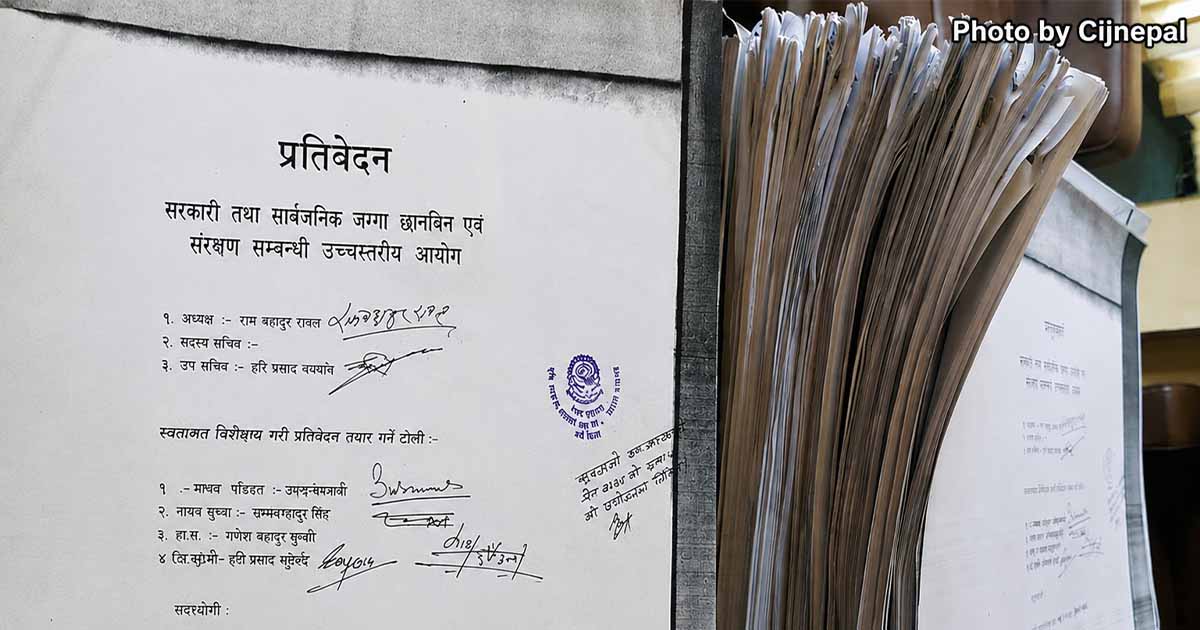
A cabinet decision to implement the Rawal Commission report has brought a decades-old land controversy back into the national spotlight. The move comes shortly after the government drew attention with its decision to reopen files related to the 2001 royal palace massacre, and is now being presented as another attempt to address unresolved state matters that successive governments left untouched.
If carried through, the decision could lead to the recovery of more than 1,859 ropanis of government land identified as having been encroached upon inside Kathmandu Metropolitan City. The land is estimated to be worth well over Rs 200 billion at current market prices.
The decision has also triggered discussions across Kathmandu, as individuals and institutions occupying public land in different parts of the city may face legal scrutiny and possible eviction. For many, the significance of the move lies not only in the value of the land involved but in the fact that the report remained largely unimplemented for more than three decades despite court directives and repeated public concern over public property being absorbed into private ownership.
A Commission Formed After Democracy’s Return
The origins of the Rawal Commission trace back to January 1993, when concerns were growing over the rapid disappearance of government, public and guthi land in Kathmandu following the restoration of multiparty democracy.
The government led by then Prime Minister Girija Prasad Koirala formed a high-level commission under former government secretary Ram Bahadur Rawal. Its mandate was to identify public land that had been occupied or transferred into private hands and determine how those transactions had occurred.
Using the 1964 cadastral survey as a baseline, the commission conducted extensive field investigations across all wards of Kathmandu.
After three years of work, the commission submitted its report to the government in 1995.
What the Investigation Found
The commission concluded that a substantial portion of public land within Kathmandu had either been directly occupied or incorporated into private holdings.
According to the report:
- More than 1,859 ropanis of public land were found to have been encroached upon.
- Approximately 2,070 land parcels were identified as being affected.
- More than 8,000 individuals and institutions were linked to the occupation or transfer of public land.
The findings covered areas across Kathmandu and pointed to long-term weaknesses in land administration and oversight.
Recommendations That Stayed on Paper
The 1,350-page report recommended immediate recovery of the identified land and legal action against those responsible for unlawful occupation.
It also called for the cancellation of land ownership certificates obtained through irregular means and action against officials in land revenue and survey offices found to have facilitated such transfers.
Another recommendation was the creation of a systematic digital record of public land to prevent future encroachment.
Despite the scale of the findings, the recommendations were never fully implemented.
For years, the report remained a symbol of how major investigations into public resources could stall once powerful interests became involved.
Supreme Court Had Already Ordered Action
Public frustration over the lack of implementation eventually reached the courts.
In 2003, advocate Prakash Mani Sharma and other citizens filed a petition seeking enforcement of the report.
After years of hearings, the Supreme Court issued a directive in 2010 instructing the government to implement the Rawal Commission report with priority, describing it as an important document linked to the protection of national assets.
The court also ordered authorities to safeguard public land physically and legally and to remove unlawful occupation where necessary.
Even after that ruling, comprehensive implementation did not take place.
The Challenge Ahead
The government has indicated that the Ministry of Land Management and the Ministry of Home Affairs will lead the implementation process.
That process is expected to be complex.
Over the past three decades, many of the disputed plots may have changed hands multiple times, with some properties potentially now held by fourth- or fifth-generation buyers who were not directly involved in the original transactions.
Questions of compensation, ownership records, legal liability and enforcement are likely to arise as authorities move forward.
Political pressure may also become a factor. The report has long been associated with allegations involving influential political figures, business interests and senior officials, claims that have frequently surfaced whenever the report’s implementation is discussed.
Land Worth More Than Rs 200 Billion
The scale of the land involved has become even more significant as Kathmandu’s property market has expanded.
The identified 1,859 ropanis amount to nearly 29,758 annas of land. In major areas such as New Road, Baneshwor, Chabahil, Thapathali and Boudha, land prices today range from around Rs 7 million to more than Rs 10 million per anna.
Based on those valuations, the land identified by the commission could be worth more than Rs 200 billion.
Whether the government succeeds where previous administrations failed remains uncertain. But the decision has reopened one of Nepal’s longest-running disputes over public property and state accountability, with implications reaching every corner of Kathmandu.