Nepal and China used a high-level meeting in Beijing on Monday to revisit some of the most sensitive and strategic issues shaping their relationship, from border connectivity and infrastructure cooperation to political trust and regional positioning.
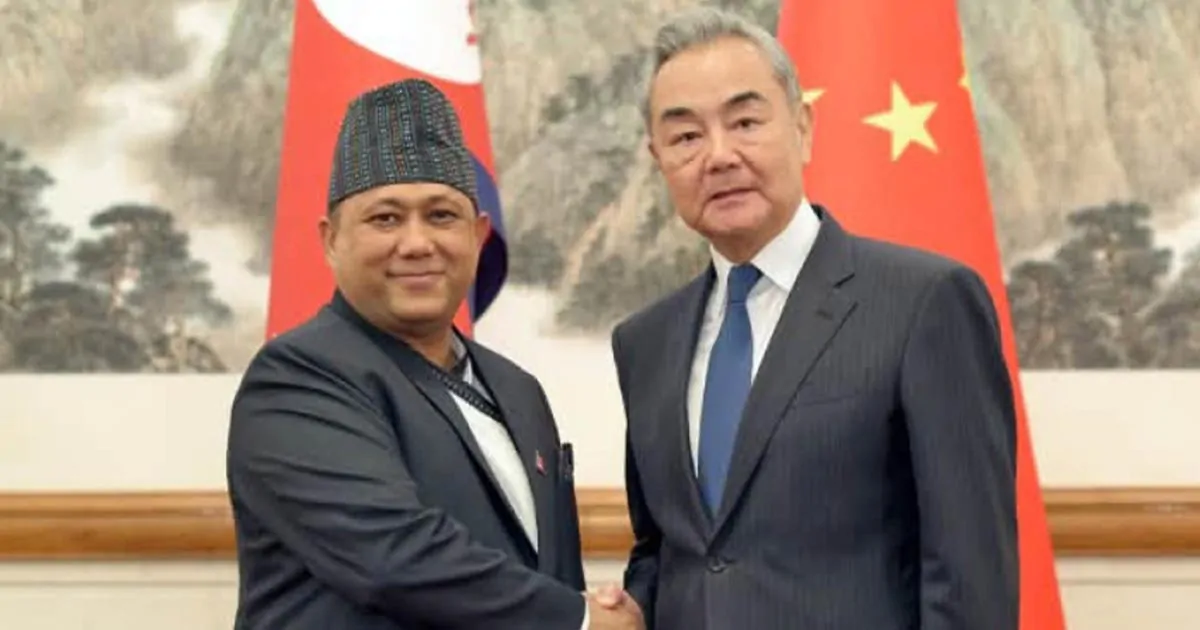
Foreign Minister Shishir Khanal, who is on a four-day visit to China, held talks with Chinese Foreign Minister Wang Yi as both sides reviewed ongoing projects and discussed the future direction of bilateral cooperation. The meeting came at a time when Nepal is seeking greater investment and infrastructure support while balancing its relations with multiple international partners.
During the talks, Khanal reiterated Nepal’s commitment to the One-China policy, stating that Taiwan and Tibet are internal matters of China. He also reaffirmed that Nepali territory would not be allowed to be used for activities directed against China.
Beijing, in turn, restated its support for Nepal’s sovereignty, independence and territorial integrity. Wang described Nepal as a trusted neighbour and development partner, and said China would continue supporting Nepal’s development efforts.
Connectivity Push Back on the Table
A major focus of the discussions was cross-border connectivity.
Nepal proposed four connectivity corridors linking the northern border with central Nepal, including the long-discussed trans-Himalayan railway project. Energy transmission infrastructure, road networks, air connectivity and expansion of border facilities were also part of the talks.
For Kathmandu, connectivity projects have increasingly become central to its economic aspirations, particularly as it seeks to improve access to northern trade routes and strengthen infrastructure in remote regions.
China expressed interest in advancing projects linked to the Belt and Road Initiative (BRI). Discussions also touched on Nepal’s possible participation in Chinese-led international initiatives, including the Global Development Initiative and the Global Civilization Initiative.
Political Discussions Beyond Infrastructure
The conversations were not limited to development projects.
Members of the Nepali delegation said the two sides also exchanged views on Nepal’s current political situation and broader geopolitical developments. Chinese officials showed interest in Nepal’s commitment to maintaining a non-aligned foreign policy.
The issue of Western engagement in Nepal, including American-supported assistance projects, was also raised informally during the visit.
These discussions reflected the broader political dimension of Nepal-China relations, where economic cooperation often intersects with regional strategic interests.
Pokhara Airport Case Draws Attention
Chinese officials also sought updates on the corruption case filed against a Chinese company involved in the construction of Pokhara International Airport.
The Nepali side responded that the investigation and court proceedings were being handled independently by the relevant institutions and that the government had no direct role in the filing of the case.
The issue has attracted attention in both countries because of the airport’s significance and its association with wider Nepal-China infrastructure cooperation.
Expanding Areas of Cooperation
The meeting also explored cooperation in several other sectors, including:
- Agriculture
- Information technology
- Digital transformation
- Tourism
- Chemical fertilizers
- Petroleum and natural gas exploration
Both sides agreed on the need to accelerate implementation of previously signed agreements and ongoing projects.
As part of his visit, Khanal also met the head of the International Department of the Communist Party of China (CPC), where discussions focused on political relations and broader bilateral cooperation.
The Beijing meetings are being viewed in Kathmandu as an important indicator of how Nepal and China intend to shape their next phase of engagement, with connectivity, economic cooperation and political trust remaining at the centre of the relationship.