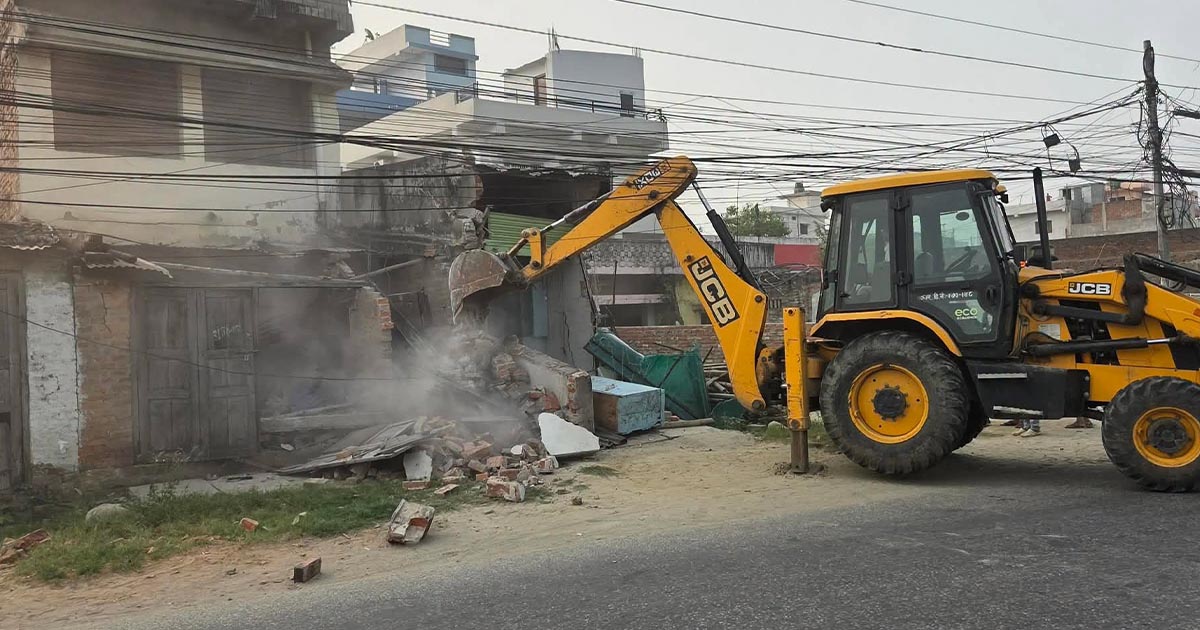
Birgunj’s main market witnessed large-scale demolition on Sunday morning, as authorities began clearing structures falling within the road expansion zone. More than 1,200 houses, shops, and commercial buildings were affected, turning the busy market area into dust within hours.
Bulldozers started operating early in the morning, catching some residents unprepared. While some had already removed their belongings overnight, others were still inside their homes or shops when demolition began.
Videos of the demolition quickly went viral on social media, drawing mixed reactions. Some supported the move as a long-overdue step toward development, while others criticized the short notice and the humanitarian impact.
What Happened in Birgunj Today?
The demolition in Birgunj is not a sudden decision. It is the result of a long-pending road expansion plan that dates back around 13 years.
After the end of Nepal’s decade-long civil conflict, the government led by former Prime Minister Baburam Bhattarai in 2011 (2068 BS) initiated a nationwide plan to widen major urban roads.
Under this policy, a 25-meter right-of-way on both sides of main roads was to be strictly enforced. Any structure falling within this boundary would be subject to removal.
Why Were Houses in Birgunj Demolished?
The structures were not demolished because they were built on government land. Instead, they fell within the legally defined road expansion boundary.
In 2012 (2069 BS), the Department of Roads issued notices to clear structures along Birgunj’s main road, stretching from Powerhouse to Miteri Bridge under the Tribhuvan Highway corridor.
However, affected property owners challenged the decision in court, delaying implementation for years.
Legal Battle and Supreme Court Decision
More than 1,200 property owners filed petitions at the Supreme Court, arguing that the decision should be revoked or compensation should be provided.
The case remained pending for years. Finally, on Falgun 28, 2081, the Supreme Court ruled in favor of the government, stating that structures within the 25-meter boundary were illegal and could be removed.
The detailed written order was later issued on Falgun 24, 2082, clearing the way for implementation.
Why Did the Demolition Happen Now?
Following the court’s full order, local authorities held a coordination meeting involving the Chief District Officer, Birgunj Mayor, road division officials, and security agencies.
The meeting decided to immediately enforce the Supreme Court’s decision and begin demolition along the main road from Powerhouse to Miteri Bridge.
12-Hour Notice Sparks Controversy
Authorities issued a notice on Saturday evening, asking residents to clear structures within the affected area before 4:30 AM Sunday.
This gave locals only around 12 hours, mostly overnight, to remove their belongings.
While some complied, others were unable to do so in such a short time. As a result, bulldozers moved in early Sunday, leading to scenes of chaos and distress.
Were Residents Informed Earlier?
Officials claim that multiple notices had been issued over the past 13 years, including deadlines of 35 days and 15 days, urging residents to remove structures voluntarily.
However, many locals argue that the final notice was too short and insufficient for proper preparation.
Public Reaction: Development vs Displacement
The demolition has triggered mixed reactions.
Supporters say the enforcement of long-delayed infrastructure projects is necessary for development. Critics, however, highlight the human cost and question the short notice and lack of rehabilitation measures.
For many families, the demolition represents not just legal enforcement, but a sudden loss of homes and livelihoods.
Conclusion
The Birgunj demolition is the result of a long-standing policy, years of legal disputes, and a final push for enforcement.
It highlights the complex balance between infrastructure development and social impact in Nepal’s urban planning.