Kathmandu Authorities Demolish Illegal Building Section
Partial demolition in Anamnagar targets structure built on public land after it went viral online


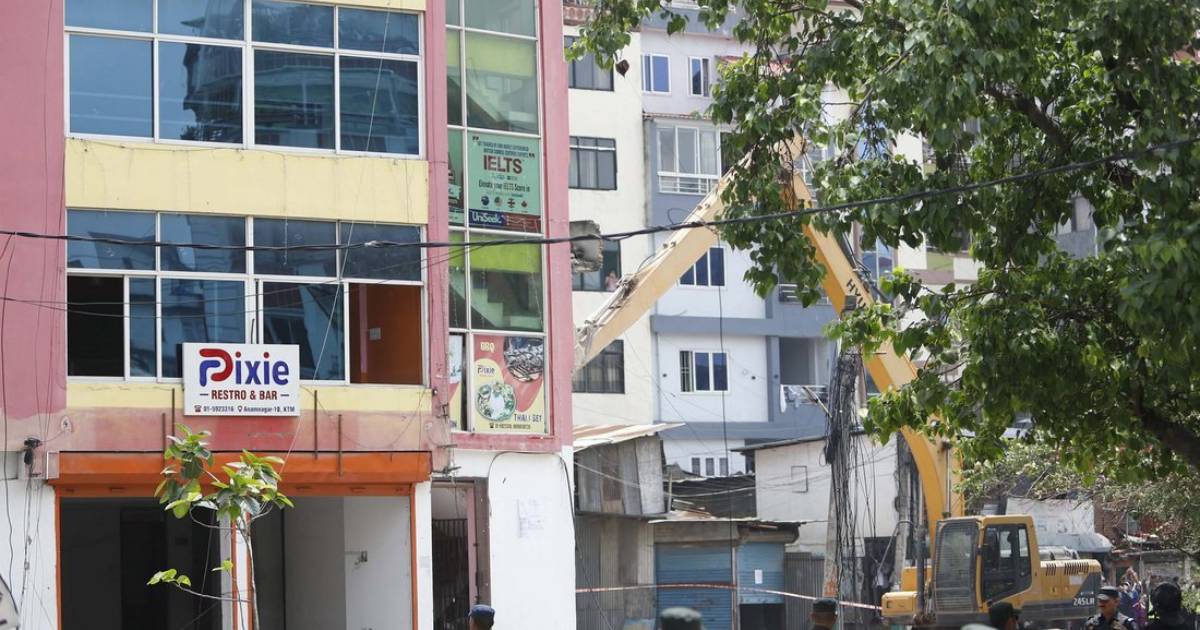
A seven-storey building constructed on public land along the Dhobikhola corridor in Kathmandu has been partially demolished by city authorities, intensifying debate over land use, urban planning, and enforcement.
The structure, located in the Anamnagar area, drew widespread public attention after images and videos of the demolition spread rapidly online.
Officials began tearing down a section of the building facing the road on Sunday morning, citing violations of established construction standards. The action has not only affected the property owner but also raised broader concerns about how similar cases have been handled across the capital.
Demolition Begins After Viral Attention
The demolition operation started early Sunday, following growing public scrutiny over the building’s legality. Social media platforms had been flooded with posts about the structure since Saturday, amplifying pressure on authorities to act.
Heavy equipment, including bulldozers, was deployed at the site, drawing large crowds of onlookers. Many gathered to witness the operation as crews began dismantling part of the seven-storey structure that was found to have breached regulatory limits.
Authorities Cite Violation of Standards
City officials stated that the building did not comply with required construction norms, particularly those related to land use along the river corridor. The structure was identified as encroaching on public land, prompting enforcement measures.
The demolition was limited to a section of the building, specifically the portion extending toward the roadside. Before work began, residents and occupants were asked to vacate the affected area to ensure safety during the operation.
Owner Claims Legal Ownership and Approval
The property owner, Indra Chamling, spoke to journalists during the operation and defended the construction. He asserted that he possesses official land ownership documents and maintained that the building was developed with government approval.
According to Chamling, authorities had previously approved the building design and collected revenue related to the property. His claims have added complexity to the situation, raising questions about how approvals were granted and whether oversight mechanisms were properly followed.
Wider Crackdown Along Dhobikhola Corridor
The demolition is not an isolated case. Authorities confirmed that other structures built along the Dhobikhola riverbank, also identified as encroachments, have been subjected to similar action.
The ongoing clearance drive appears to be part of a broader effort to reclaim public land and enforce urban planning rules in Kathmandu. Officials have indicated that structures violating regulations, particularly those built on riverbanks and public land, are under review.
- Multiple buildings along the Dhobikhola corridor identified as encroachments
- Partial demolition carried out on structures violating standards
- Safety measures taken before demolition, including evacuation
- Use of heavy machinery such as bulldozers for enforcement
Public Reaction and On-Site Crowd
The scene in Anamnagar drew significant public attention, with crowds gathering to observe the demolition. The viral nature of the incident contributed to heightened curiosity and discussion among residents.
Many observers expressed interest in how authorities would handle similar cases in other parts of the city. The visible enforcement action has sparked broader conversations about fairness, consistency, and transparency in urban governance.
Questions Over Approval and Accountability
The owner’s claim that the building was constructed with official approval has led to renewed scrutiny of regulatory processes. If permits were indeed granted, it raises concerns about how such a structure came to be classified as non-compliant.
This situation highlights potential gaps in coordination between agencies responsible for land management, construction approval, and enforcement. It also underscores the challenges faced by authorities in addressing past decisions while implementing current regulations.
Impact on Urban Policy and Enforcement
The demolition of the seven-storey building in Anamnagar is likely to influence future enforcement actions in Kathmandu. Authorities may face increased pressure to ensure consistent application of rules across all cases, especially where public land is involved.
The incident serves as a reminder of the complexities surrounding urban expansion in rapidly growing cities. Balancing development with adherence to planning standards remains a critical issue, particularly in areas prone to encroachment.
As the clearance drive continues, attention will remain on how authorities manage similar cases and whether a clearer framework emerges for addressing disputed constructions.


Written by Roshani Shrestha Pathak
Roshani Shrestha Pathak is the English Bureau Chief at Khoj Samachar, overseeing English-language editorial operations and newsroom coordination.
Nepal Government to Print National ID Cards Itself
Everything You Need to Know About the 2026/27 National Budget

Singha Durbar Toilets Remain in Poor Condition
Manoj Kumar Sharma Set to Become Nepal’s Chief Justice

Koshi Police Honors Inspector Sagar Sah for Innovative Policing

Asim Shah Reacts to Possible Gen Z Boycott of Talks