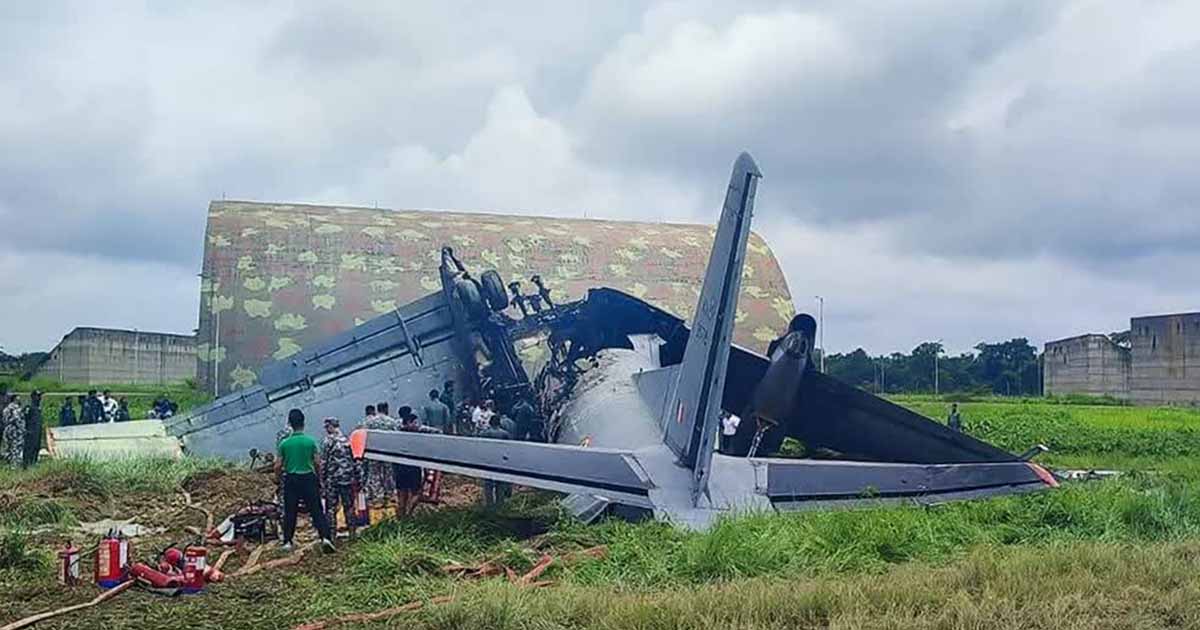
The crash of an Indian Air Force AN-32 transport aircraft during landing at the Jorhat Air Force Station in Assam on Saturday has once again drawn attention to the long and troubled safety record of one of the military’s most heavily used transport platforms. Five Air Force personnel were killed in the accident, while the co-pilot survived and is undergoing treatment.
The Indian Air Force identified the deceased as Squadron Leader Prashant Singh, Flight Lieutenant Shubham Kumar, Sergeant Jitendra Sharma, Agniveervayu Khemaram Kumawat and Agniveervayu Danish Alam. The force paid tribute to them as personnel who lost their lives in the line of duty.
Defence Minister Rajnath Singh expressed grief over the loss of lives and offered condolences to the families of the deceased. The Air Force has initiated a formal investigation to determine the cause of the crash.
An Aircraft With a Difficult History
For decades, the AN-32 has been a key part of the Indian Air Force’s logistics network, particularly in remote and difficult terrain where troops, equipment and supplies must be moved under challenging conditions.
Its operational importance, however, has often been overshadowed by a series of fatal accidents.
In 2019, an AN-32 crashed in Arunachal Pradesh, killing all 13 people on board. A similar tragedy occurred near Mechuka in 2009, also claiming 13 lives.
One of the deadliest accidents involving the aircraft took place near New Delhi in 1999. The aircraft crashed while attempting to land in poor weather, killing 18 people on board and three others on the ground.
Not Every Accident Ended in Loss of Life
Several AN-32 incidents over the years have resulted in severe damage to aircraft without causing fatalities.
- All passengers survived an AN-32 accident during landing at Bagdogra in West Bengal in March 2025.
- Nine people escaped safely after an aircraft caught fire following an accident in Chandigarh in September 2014.
- A crash at Jorhat in December 2011 caused no loss of life.
- All personnel survived after an AN-32 went down near Bengaluru in February 2000.
These incidents have repeatedly highlighted both the resilience of crews and the operational risks associated with aging military transport aircraft.
Accidents Stretch Back Decades
The aircraft’s accident history extends to the early years of its service.
In 1992, two AN-32 aircraft collided mid-air during a night training exercise in Punjab, killing eight military personnel. Another crash in Kerala in 1990 claimed the lives of five crew members.
Earlier accidents in Uttar Pradesh in 1988 and Jammu and Kashmir in 1986 resulted in 10 and 17 deaths respectively.
Fresh Focus on Modernisation
While investigators have yet to determine what caused the latest crash at Jorhat, the incident has reignited discussion within defence circles about fleet maintenance, service life management and the pace of military aviation modernisation.
The AN-32 remains vital to operations in difficult terrain, but every major accident adds pressure on authorities to ensure that transport aircraft operating in demanding environments receive the upgrades, maintenance support and safety oversight necessary to prevent similar tragedies in the future.
For now, attention remains on the ongoing investigation and on the five Air Force personnel whose lives were lost during a routine military mission.