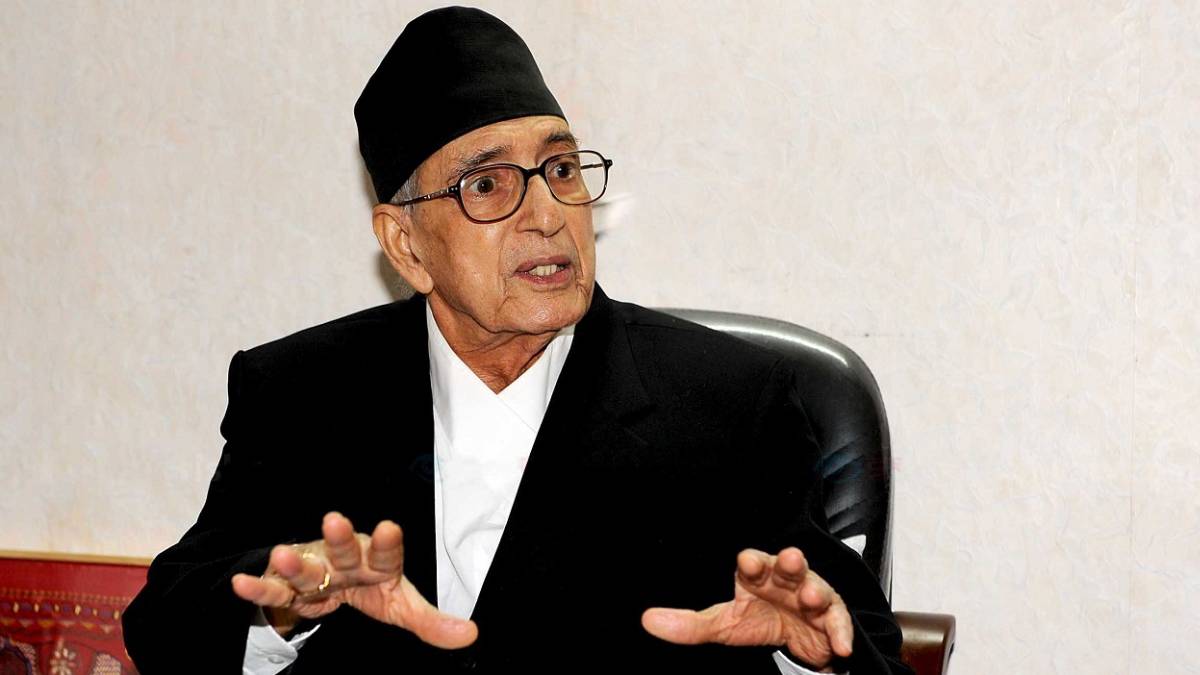
Kathmandu — Nepal is observing the 16th memorial day of former Prime Minister and former Nepali Congress President Girija Prasad Koirala today, with various programs being organized across the country to honor his legacy.
Girija Prasad Koirala’s Leadership in Nepal’s Democratic Movement
Koirala, who served as Prime Minister four times, passed away on Chaitra 7, 2066 BS due to pneumonia. He is widely recognized for leading Nepal through a critical period of political transition and for guiding the country from conflict toward peace.
The political crisis intensified after King Gyanendra dismissed the elected government on Ashoj 18, 2059 BS. Koirala led a series of political movements that gradually weakened public support for the monarchy and strengthened democratic forces.
After King Gyanendra assumed direct rule on Magh 19, 2061 BS, Koirala united major political parties and led a nationwide movement for the restoration of democracy. This movement resulted in the reinstatement of the House of Representatives on Baisakh 11, 2063 BS, a major turning point in Nepal’s political history.
Role of Girija Prasad Koirala in Peace Process and Constitutional Transition
He played a key role in ending the Maoist “people’s war” and advancing the peace process. During a time of instability, he helped foster cooperation among political parties and pushed the country toward an inclusive democratic system.
Under his leadership, the management and integration of Maoist combatants were carried out, contributing to long-term peace. The Constituent Assembly election was held on Chaitra 28, 2064 BS, fulfilling a long-standing vision of Nepali Congress founder and his elder brother, B.P. Koirala.
Although the first Constituent Assembly could not deliver a constitution, it marked a historic shift in Nepal’s political landscape. The process brought the Maoists into mainstream multiparty democratic politics.
Girija Prasad Koirala’s Role in Establishing Federal Democratic Republic Nepal
Following the success of the movement, Koirala became Prime Minister for the fourth time. The reinstated parliament then curtailed the powers of the monarchy, reducing the king to a ceremonial role.
On Jestha 15, 2065 BS, under his leadership, Nepal formally abolished the 240-year-old monarchy and was declared a federal democratic republic. After King Gyanendra was suspended, Koirala also served as acting head of state.
Known for honoring his commitments, Koirala is remembered as a decisive and influential statesman in Nepal’s modern political history. On the occasion of his 16th memorial day, the Nepali Congress, along with its affiliated and well-wisher organizations, is holding various programs across the country to pay tribute to his contributions.