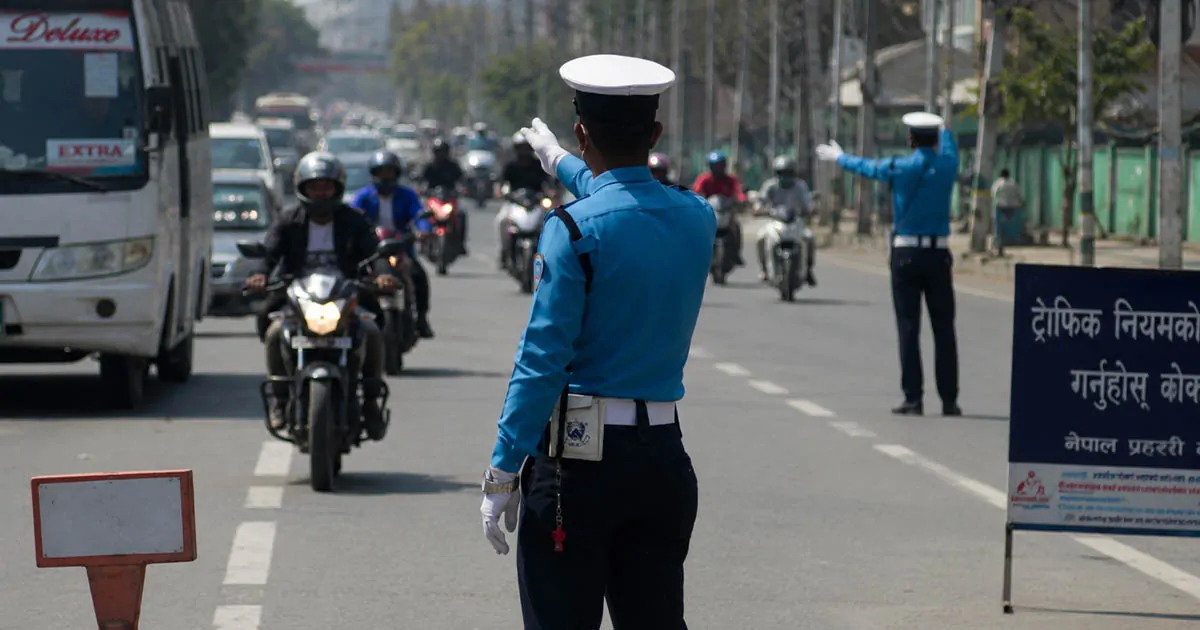
The Nepal government has moved forward with a proposal to sharply increase penalties for traffic rule violations, signalling a tougher approach to road discipline. The Ministry of Physical Infrastructure and Transport has prepared a new bill that would impose significantly higher fines on both drivers and pedestrians if approved through the legislative process.
The proposal reflects the government’s broader effort to strengthen enforcement at a time when road safety and traffic management continue to be major public concerns. However, the bill is still under legal review and may undergo changes before becoming law.
Bill Sent for Legal Review
The government-owned newspaper The Rising Nepal reported on June 26 that the ministry has already forwarded the draft legislation to the Ministry of Law, Justice and Parliamentary Affairs for review.
After the legal review is completed, the bill will be presented to the Cabinet. It must then be registered in both the House of Representatives and the National Assembly before being passed and authenticated by the President to take legal effect.
Until then, the proposed provisions remain subject to amendment.
Major Increase in Penalties
If enacted in its current form, the bill would introduce fines ranging from Rs 500 to as much as Rs 100,000 depending on the offence.
- Using tinted glass beyond the permitted standard: fine of up to Rs 100,000.
- Driving above the prescribed speed limit or driving under the influence of alcohol: fine between Rs 25,000 and Rs 50,000.
- Running a traffic signal: fine between Rs 3,000 and Rs 5,000.
- Crossing the road outside a zebra crossing or designated crossing point: Rs 500 fine.
- Honking in prohibited zones: Rs 500 fine.
- Littering on roads: Rs 1,000 fine.
- Failing to carry required documents such as a driving licence, vehicle registration book or insurance papers: Rs 1,000 fine.
The draft also introduces a margin for speed enforcement. Drivers exceeding the posted speed limit by up to five percent would not be penalised.
For example, if the speed limit is 60 km/h, driving at up to 63 km/h would not attract a fine. Any speed beyond that threshold would be treated as a violation.
Spot Fines and Repeat Offenders
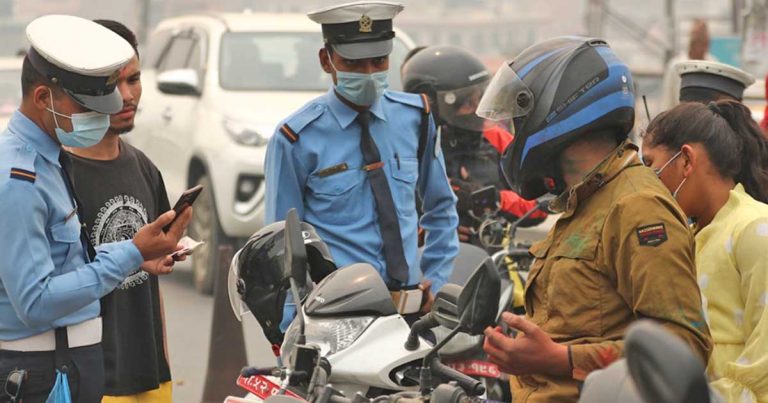
The proposed law would authorise Assistant Sub Inspectors (ASI) of Nepal Police Traffic and higher-ranking officers, along with transport inspectors, to issue spot fines at the location of the offence.
The government also plans to require fines to be paid digitally, including through the Nagarik App and other electronic payment systems.
Drivers who fail to pay immediately could have their driving licence, vehicle registration certificate or route permit temporarily confiscated. Those documents would be returned once the fine is settled.
The bill also seeks stricter penalties for repeat offenders.
- A second violation of the same offence would result in an additional 50 percent fine.
- A third and every subsequent violation would attract double the original penalty.
A Familiar Idea Beyond Reality
The proposal has drawn attention because of its resemblance to a fictional policy portrayed in the 2018 Indian film Bharat Ane Nenu, starring Mahesh Babu. In the film, the newly appointed Chief Minister introduces strict traffic penalties that compel citizens to follow road rules.
In Nepal, however, the proposal is now moving through the country’s formal legislative process rather than remaining a cinematic idea.
Whether the proposed law ultimately leads to better road discipline or simply increases the financial burden on the public will depend not only on the size of the fines but also on how fairly and consistently the rules are enforced.