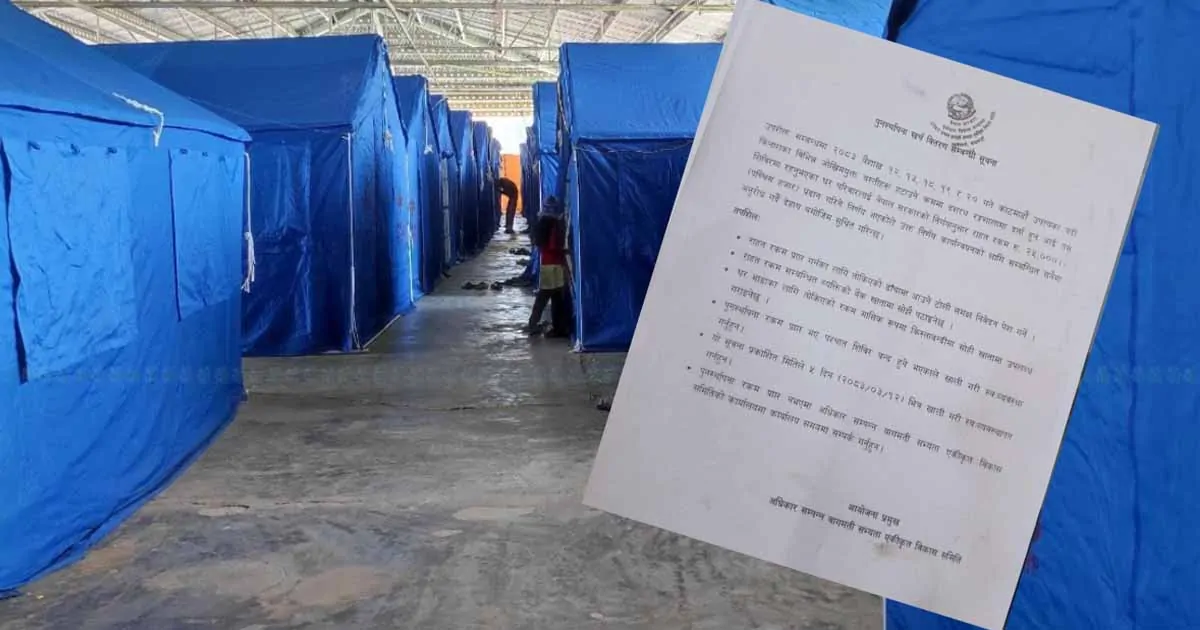
A government notice directing landless families to vacate all holding centres within the next five days has triggered intense public debate, with concerns growing over the future of hundreds of displaced households at the very start of the monsoon season.
The decision has renewed scrutiny of the government’s handling of landless settlements after Prime Minister Balen Shah’s administration launched a campaign to remove settlements located along riverbanks and nearby public land across the Kathmandu Valley. The operation saw large deployments of security personnel as one settlement after another was cleared.
Today, 388 displaced landless families remain housed in holding centres located in Kirtipur, Ichangunarayan, Kharipati and Dhulikhel.
Families Spend Two Difficult Months in Temporary Shelters
The 388 families living in the holding centres have spent the last two months under difficult conditions, repeatedly complaining about the lack of adequate basic services and facilities.
Inspections carried out by the National Human Rights Commission and parliamentary committees concluded that the government had failed to ensure sufficient living conditions for those displaced during the eviction campaign.
With the monsoon season already underway since Asar 10, the government’s latest directive requires all remaining families to leave the holding centres within five days.
For many families, the announcement has created new uncertainty rather than relief.
Government Offering Cash Support and Rent Assistance
Under the government’s new plan, financial support will be provided to the 388 families currently staying in holding centres, along with verified landless households who managed their own accommodation after their homes were demolished.
Each family will receive a one-time payment of Rs 25,000 and will be expected to arrange housing independently.
The government also plans to provide Rs 15,000 per month in rental support for the next three months.
Officials say the administration aims to distribute land ownership certificates to all verified landless families within that three-month period.
However, Bagmati Civilization Development Committee Director Machakaji Maharjan has acknowledged that no clear plan currently exists if the land certificate distribution process is not completed within the announced deadline.
Temporary Solution Carries a Growing Cost
The government’s immediate relief package is expected to require substantial spending.
Providing the initial Rs 25,000 payment to 388 families will cost approximately Rs 97 lakh.
The additional rental assistance of Rs 15,000 per month for three months will amount to Rs 1 crore 74 lakh 60 thousand.
Combined, the two programmes will cost around Rs 2 crore 71 lakh 60 thousand for the families currently living in holding centres.
That figure could rise sharply if the same support is extended to other verified landless families who found accommodation on their own after the demolitions. Current estimates suggest total spending could reach between Rs 5 crore and Rs 10 crore.
Any delay in land certificate distribution would further increase the financial burden.
A Debate Over Planning and Priorities
The latest development has intensified discussion over whether the government should have completed the identification of genuine landless households and prepared a long-term resettlement strategy before carrying out large-scale evictions.
Many argue that the crores of rupees now being spent on temporary relief and rent support could have been invested in planned housing projects, land management programmes and permanent rehabilitation measures.
Supporters of that view believe a more structured approach could have reduced both public expenditure and the hardships faced by displaced families.
The issue has also become a broader test of how the government balances urban management, public land protection and the rights of vulnerable communities.
Permanent Rehabilitation Remains the Real Challenge
The landless settlement issue remains one of Nepal’s most complex social and economic challenges.
For many families, receiving a land certificate alone will not be enough. Permanent housing, drinking water, electricity, roads, schools and access to public services will still need to be ensured.
As the five-day deadline approaches, uncertainty continues to overshadow the government’s promises. While there is broad agreement that a long-term solution is necessary, questions remain over the process, preparation and implementation of that solution.
For the hundreds of displaced families now preparing to leave temporary shelters, the biggest concern remains unchanged: when will permanent rehabilitation become a reality, and what happens if the promised land distribution does not arrive on time?