Nepal’s politics has once again taken a dramatic turn. As the saying goes, anything can happen here — what seemed impossible just days ago is now unfolding in front of everyone.
Until recently, Pushpa Kamal Dahal and his party leaders were among the strongest critics of KP Sharma Oli. But now, the same leaders appear to be moving towards cooperation, with discussions reportedly reaching a decisive stage.
Meeting at Teaching Hospital
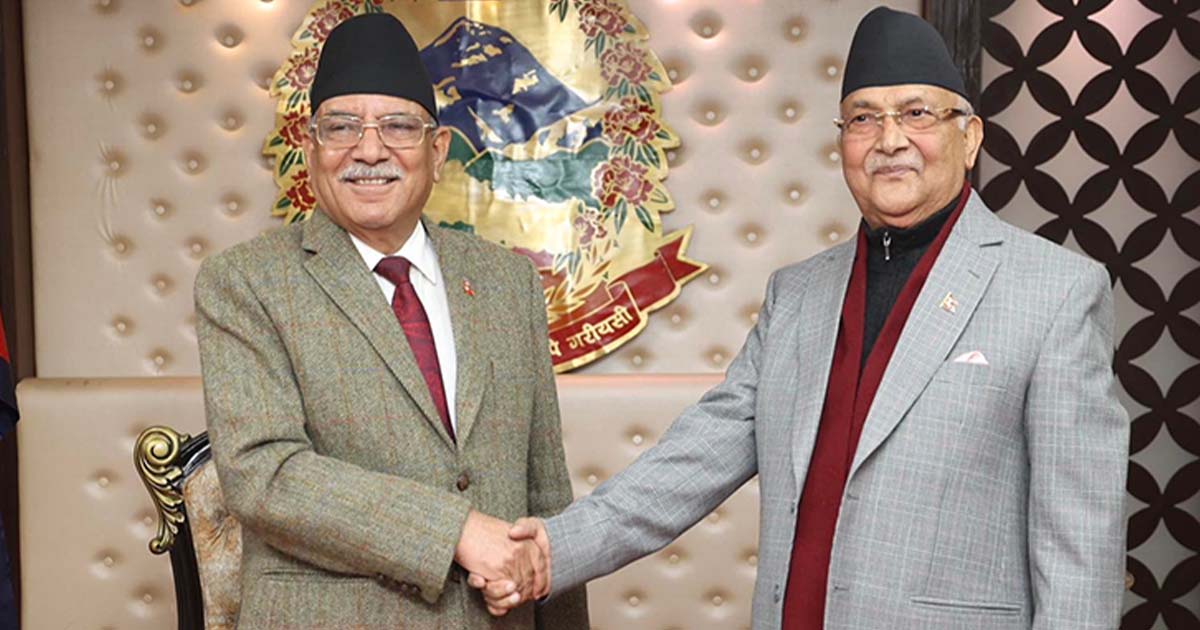
For the past few days, continuous talks have been taking place between leaders aligned with the Communist bloc and the UML. As part of this, Prachanda visited Oli at Kathmandu’s Teaching Hospital on Thursday.
Oli, who was released on a court order under a routine appearance arrangement, is currently recovering in hospital following a recent kidney stone surgery.
The meeting between the two leaders lasted around 30 minutes. According to sources, along with wishing Oli a speedy recovery, discussions also touched on the possibility of political cooperation and even party unity.
Why Are Former Rivals Moving Closer?
The shifting political landscape appears to be a key factor. With the rise of a new and powerful government force, older parties are increasingly under pressure.
There is growing discussion that traditional political forces may be trying to come together to form a stronger opposition.
At the same time, Home Minister Sudan Gurung has reportedly taken a tough stance, saying “no one will be spared,” At the same time, legal actions and arrests targeting several high-profile political figures have intensified, adding further pressure on established parties.. This has created visible unease across established political circles.
Although some of those Although some of those arrested have been released by courts within days, the situation has raised serious concerns across Nepal’s political landscape., the act of being detained itself has become a major reputational blow for well-known leaders.
Asset Investigations Add to Pressure
The government is also said to have formed a commission to investigate the assets of senior political leaders and officials dating back to the 2006 movement, further increasing pressure on established political figures.
There is speculation that once the commission’s report becomes public, it could implicate a large number of top-level figures. However, no official findings have been released yet.
Questions are likely to be raised about the source of wealth of leaders who rose to power from years of political struggle, including those from the Maoist movement. But again, these claims remain under discussion without formal confirmation.
Growing Fear Among Established Parties
Among older political forces, two major concerns are emerging:
- Expanding legal scrutiny
- Possibility of political retaliation
This appears to be pushing leaders towards the idea that unity may be necessary to respond to the current situation.
A Familiar Pattern: Unity and Collapse
Nepal has seen this before. Leftist forces once united and formed a near two-thirds majority government. But internal conflicts soon led to its collapse.
At one point, Prachanda and Madhav Nepal’s faction even moved to sideline Oli within the party. The situation later led to splits, the formation of new parties, and multiple political realignments.
What Happens Next?
Now, with talks of unity returning, the key question remains:
Can this alliance last this time?
Past experience suggests otherwise. Even with full control of government power, these forces failed to stay united. Whether they can maintain cooperation now, from a weaker position, remains uncertain.
Conclusion
Nepal’s political equations change quickly, and this latest development is another example.
The meeting between Prachanda and Oli signals a possible shift, but whether it leads to a stable and lasting alliance is still an open question.