Many Facebook users have been talking about a new content monetization challenge that has recently appeared on the platform. Posts, videos, and screenshots shared across social media claim that Facebook has introduced a simpler requirement for creators to qualify for content monetization — reaching 300,000 views within 28 days.
At the same time, Facebook has started displaying a pop-up titled “Unlock Content Monetization” inside the monetization section for many users. According to the notification, creators who reach 300,000 views within 28 days may become eligible for a content monetization invitation, provided their content complies with Facebook’s policies and guidelines.
Seeing this notification, many users have assumed that reaching the 300,000-view milestone automatically unlocks monetization. However, a practical test conducted by Khoj Samachar suggests that the process is not quite that straightforward.
How Khoj Samachar Tested Facebook’s New Monetization Challenge
Shortly after Facebook rolled out the update, Khoj Samachar decided to test the challenge firsthand.
The first step was clicking the “Join Challenge” button. After joining, a video was uploaded to a newly created Facebook page operated by Khoj Samachar.
As the video began gaining traction, the view count displayed inside the monetization challenge box increased at the same pace. Within just a few hours, the video crossed 300,000 views, successfully meeting Facebook’s stated target.
Despite achieving the required milestone, the page did not receive access to content monetization.
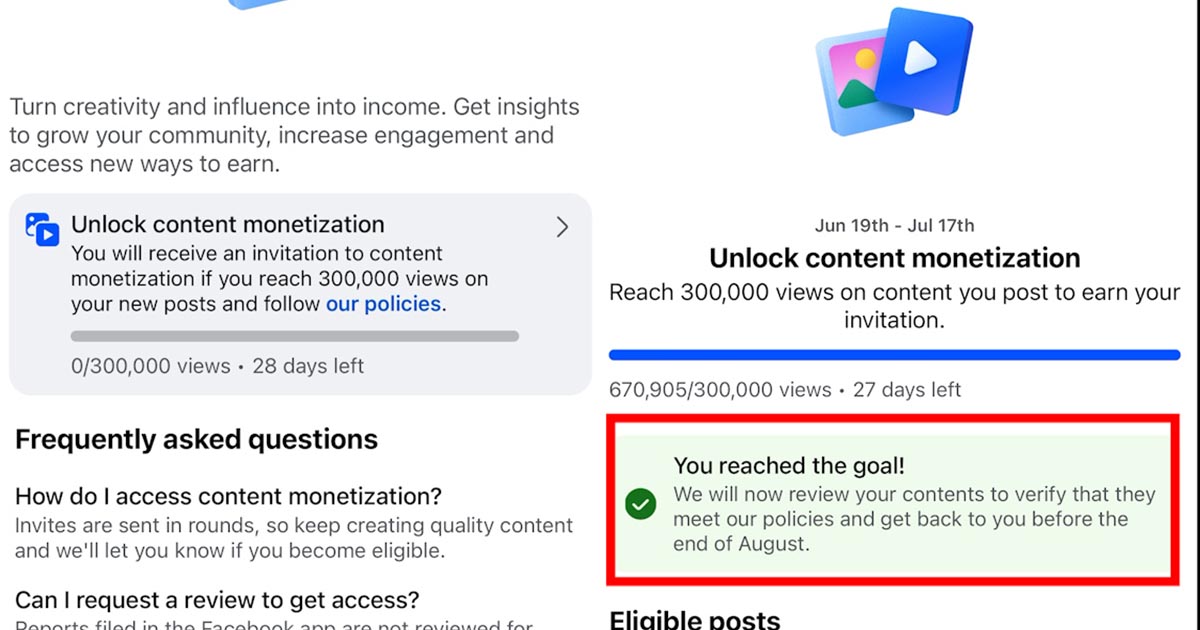
In fact, the page has now accumulated more than 670,000 views—well above the original 300,000-view requirement—yet monetization has still not been activated.
Instead, Facebook displayed a message reading “You Reached The Goal.”
Below that message, the platform explained that it would review the page’s content and determine whether it qualifies for monetization based on compliance with Facebook’s rules and standards. The notification further indicated that a final decision could be made by the end of August.
As of writing, it has been two days since Khoj Samachar joined the challenge. Facebook’s dashboard shows that the challenge began on June 19 and is scheduled to end on July 17. However, the required 300,000 views were achieved within just two days.
This suggests that receiving a monetization invitation may depend on factors beyond simply reaching the target view count. Content quality, policy compliance, account history, and Facebook’s internal review process may all play a role in the final decision.
Whether Facebook introduces additional updates in the coming weeks—or when exactly this page receives a monetization invitation—remains to be seen.
What the test clearly demonstrates, however, is that reaching 300,000 views does not automatically guarantee immediate access to Facebook Content Monetization.
At least for now, the widespread belief that creators receive monetization as soon as they hit the target appears to be inaccurate.
Do Only Video Views Count, or Do Photos and Status Posts Count Too?
During the testing process, Khoj Samachar also discovered another important detail about the challenge.
Many creators assume that the required 300,000 views must come exclusively from videos or Reels. However, available indications suggest that Facebook may also count qualified views generated through other forms of content, including photos, status updates, and similar posts published on a page or profile.
This makes sense because Facebook Content Monetization is not limited to videos alone. The program is designed to reward creators across multiple content formats, including videos, Reels, photos, stories, and text-based posts, depending on eligibility and performance.
Naturally, one question many creators ask is: “If your page reached 300,000 views in just a few hours, how can ordinary creators achieve the same goal?”
The good news is that the challenge lasts for 28 days. Even if creators do not reach the target immediately, there is still enough time to accumulate the required views over the course of the challenge period.
What Can Help Creators Reach 300,000 Views Within 28 Days?
One of the most important factors is identifying topics that are already trending.
For example, if a major political event is dominating public discussion, thousands of creators, media outlets, and ordinary users may be posting related videos, photos, Reels, and updates throughout the day.
When a large volume of content revolves around the same subject, Facebook’s algorithm quickly recognizes that topic as a trend.
The platform then begins analyzing related content, evaluating which posts appear useful, original, engaging, or repetitive.
If a user watches one piece of content related to a trending topic for an extended period, Facebook often responds by recommending additional content on the same subject.
Understanding this pattern can help creators improve their reach.
For anyone participating in the 28-day challenge, paying attention to what is currently trending can make a significant difference in overall performance.
How Does Facebook’s Algorithm Understand Your Content?
Many creators wonder how Facebook determines what a post is actually about.
The platform’s artificial intelligence can analyze videos and images to gain a general understanding of their content. However, it does not always interpret visual information perfectly.
Captions, on the other hand, provide much clearer signals.
Because of this, using relevant keywords associated with trending topics can help Facebook better categorize and distribute content.
For instance, if a political convention or major public event is trending, creators may notice related keywords becoming popular across the platform. Using relevant terms that genuinely match the content can help Facebook understand the subject matter more accurately.
At the same time, creators should avoid captions containing hate speech, harassment, graphic violence, threats, or offensive language. Such content can negatively affect distribution and may also impact monetization eligibility.
Another important factor is audience retention.
Simply getting content in front of users is not enough. Once people click on a video, they need a reason to stay and watch.
That is why many successful creators place the most important information at the beginning rather than spending the opening seconds on lengthy introductions.
If viewers immediately understand why the content matters, they are more likely to continue watching.
Even retaining viewers for five to ten seconds can send positive engagement signals to Facebook’s algorithm.
Ultimately, a combination of trending topics, relevant captions, original content, and strong audience retention can help creators move closer to the 300,000-view target.
However, Khoj Samachar’s test indicates that reaching the view requirement is only one step in the process. Hitting the target may qualify a page for review, but the final decision on content monetization still appears to depend on Facebook’s evaluation of the page and its compliance with platform policies.